




Reggio Emilia classroom set-up: the environment as the third teacher
How to set up a Reggio Emilia classroom: the environment as third teacher, key spaces, natural materials, light, documentation displays and furniture.
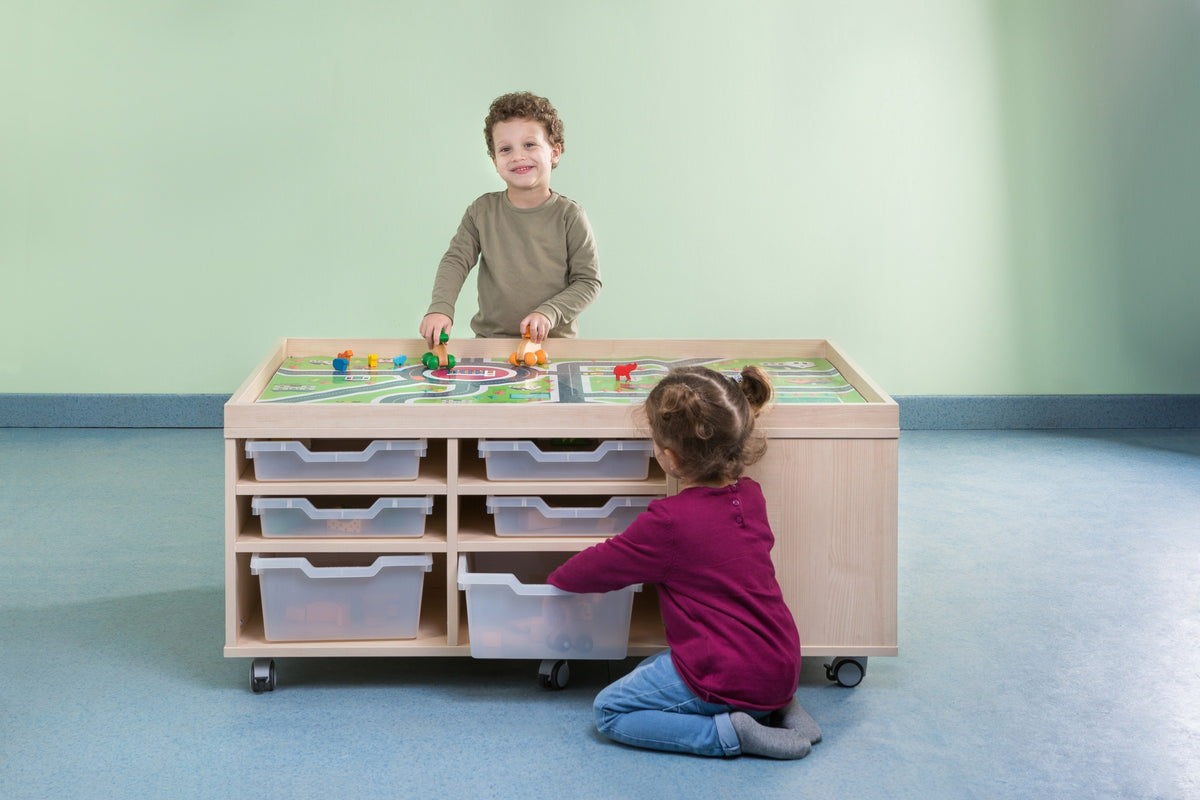
The short answer: A Reggio Emilia classroom treats the environment as the "third teacher", alongside educators and families. Set it up with calm, uncluttered spaces, plenty of natural light, mirrors and light play, natural and open-ended materials displayed invitingly on low open shelves, an art studio (atelier), a central gathering space and documentation of children's thinking at their eye level.
Key Points
- The Reggio Emilia approach sees children as capable and curious, and the room is designed to invite their ideas.
- "Environment as the third teacher" means every space, material and display is chosen with purpose.
- Natural light, mirrors, neutral backgrounds and natural materials are hallmarks of Reggio-inspired rooms.
- An atelier, a gathering space and documentation of children's work are central, not extras.
- Low, natural timber furniture keeps the focus on children and materials.
- In Australia, a Reggio-inspired room also needs to meet the National Regulations and supports EYLF and NQS Quality Area 3.
What is the Reggio Emilia approach?
The Reggio Emilia approach is an educational philosophy that grew from the municipal early childhood services of Reggio Emilia, a city in northern Italy, after the Second World War. It is closely associated with educator Loris Malaguzzi. It sees children as strong, capable and full of ideas, and learning as something children build together with adults and each other.
A few ideas sit at its heart:
- The capable child: children are seen as competent researchers of their world, not empty vessels.
- The hundred languages: children express their thinking in many ways, through drawing, building, clay, movement, music, words and more.
- Projects that emerge: learning often grows from children's questions and interests, over days or weeks.
- Documentation: educators record children's words, work and thinking, and use it to plan and reflect.
- Relationships: children, educators, families and community are all part of learning.
- The environment as third teacher: the space itself teaches.
Reggio Emilia is not a curriculum or a set of products. Services outside Italy usually describe themselves as "Reggio-inspired". That gives you freedom to adapt the ideas to your children, your community and Australian requirements.
What does "the environment as the third teacher" mean?
It means the physical environment is seen as one of children's teachers, alongside the adults in the room and other children. A well-designed space invites exploration, supports relationships and makes children's thinking visible, even when no adult is directing the play.
In practice, this asks educators to make deliberate choices about every part of the room:
- What is offered: carefully chosen materials, not everything at once.
- How it is offered: arranged attractively, so a tray or basket is itself an invitation.
- Where it is offered: placed to encourage small groups, conversation or focused solo work.
- What stays: work in progress can stay out so projects can deepen over days.
- What is shown: walls show children's ideas and processes, not commercial posters.
This links closely to the EYLF V2.0, which names learning environments as one of its practices. Our EYLF learning environment guide covers this in more depth.
What spaces does a Reggio-inspired classroom need?
Most Reggio-inspired rooms include a central gathering space, an atelier or art studio, areas for construction, light and shadow, small group work and quiet retreat. They are defined with low furniture and soft boundaries, so the room feels connected.
| Space | Purpose | What to include |
|---|---|---|
| Piazza or gathering space | A meeting place for the group, conversation and sharing ideas | A rug or open floor, a low bench, documentation nearby |
| Atelier (art studio) | Expressing ideas through materials | Clay, paint, wire, collage, drawing tools; an art trolley; work tables; drying and storage space |
| Mini-atelier | A smaller studio corner inside a room | A small table, a few chosen materials on a tray, good light |
| Construction and loose parts | Building, design, problem solving | Wooden blocks, natural loose parts, clipboards for plans |
| Light and shadow | Exploring light, colour and transparency | Light table or panel, translucent shapes, mirrors |
| Small group tables | Collaborative projects and investigation | Round or rectangular tables for small groups, natural objects to study |
| Quiet nook | Rest, reading and reflection | Soft seating, books, cushions, a semi-enclosed feel |
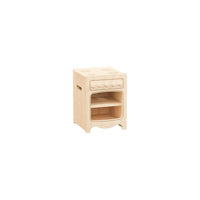
| Home corner and role play | Making sense of daily life and relationships | Real or realistic kitchen items, fabrics, natural props |
For the art space, our art area and art trolley guide covers storage and mess management, and our home corner guide covers role play.
What materials belong in a Reggio Emilia classroom?
Reggio-inspired rooms favour natural, open-ended and real materials that children can use in many ways, presented in small, beautiful collections. The aim is materials that invite questions and creativity, rather than toys with one right answer.
- Natural materials: pinecones, shells, stones, seed pods, bark, leaves, gumnuts, timber offcuts.
- Loose parts: wooden rings, cubes, buttons, corks, fabric scraps, tubes.
- Art media: clay, paint, charcoal, oil pastels, watercolour, wire, recycled materials.
- Real tools: magnifiers, measuring tapes, small hand tools used with supervision.
- Light materials: translucent shapes, coloured acrylic pieces, cellophane, mirrors.
- Wooden toys: blocks, building arches, stacking and grading towers, open-ended figures.
- Literacy and numeracy: books, clipboards, letter and number puzzles, counting materials.
Present materials in baskets, wooden bowls, glass jars (for older children, with care) and on trays, so each collection looks considered. Fewer, well-chosen materials invite deeper play than full tubs. Our range of natural wooden toys and trays suit this kind of presentation.
How do you use light, mirrors and colour?
Use natural light as your first material, add mirrors and light play to invite exploration, and keep the colour palette calm so children's work and materials stand out.
Light
- Keep windows clear of tall furniture. Regulation 110 requires ventilation and natural light, and Reggio-inspired rooms make the most of it.
- Hang translucent fabric or coloured shapes at windows to play with light and shadow.
- Add a light table or light panel for exploring transparency and colour.
- Use warm lamps or soft lighting in quiet areas where safe and appropriate.
Mirrors
- Place shatter-resistant mirrors at floor and child height so children can see themselves and their work from new angles.
- Put a mirror under or behind a construction area or a collection of natural objects.
Colour
- Choose neutral walls and natural timber furniture so the room feels calm.
- Let colour come from children's art, materials, plants and fabrics.
- Bring plants inside, and keep them cared for by the children.

How should you display children's work and documentation?
Display documentation that shows children's thinking and learning processes, not just finished pieces. Put it at children's eye level, keep it uncluttered, and change it as projects grow.
A good documentation panel usually includes:
- Photos of children at work (hands and process are often enough).
- Children's own words, written down exactly as they said them.
- A short educator reflection on what children were exploring and what might come next.
- The work itself, or part of it, where possible.
Display Tips
- Use natural frames, pegs on string, cork boards or simple timber ledges.
- Leave white space around each panel. Crowded walls are hard to read and tiring to look at.
- Include families' languages and contributions.
- Invite children to revisit documentation and add to it.
- Keep some documentation in books or folders children can look through.
What furniture suits a Reggio-inspired room?
Low, natural timber furniture in simple shapes suits a Reggio-inspired room best. It keeps the focus on children and materials, is easy to rearrange as projects change, and helps create a calm, home-like feel.
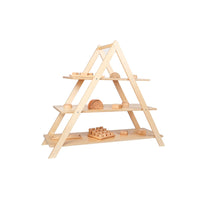
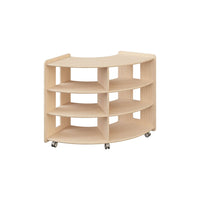
- Low open shelving to display materials invitingly and let children help themselves.
- Tables for small groups, round and rectangular, so children work and talk together.
- An art trolley to bring atelier materials to where the project is happening.
- Low room dividers to define spaces while keeping sightlines for supervision (regulation 115).
- Soft seating and cushions for quiet nooks and the gathering space.
- Display ledges and boards at child height for documentation.
- Movable pieces: furniture light enough for educators to change the room as projects evolve.
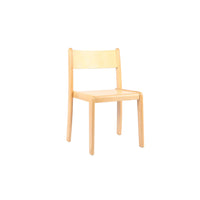
Tables and chairs still need to fit the children. Choose chairs and tables from the same size mark:
| Size mark | Typical age | Seat height | Table height |
|---|---|---|---|
| C02 | 1–2 years | 17 cm | 36 cm |
| C0 | 2–3 years | 21 cm | 40 cm |
| C1 | 3–4 years | 26 cm | 46 cm |
| C2 | 4–6 years | 31 cm | 53 cm |
Check fit with the children you have: feet flat, knees at about 90 degrees, forearms resting just below elbow height. Our size guide has the full chart.
How does a Reggio-inspired room fit Australian requirements?
A Reggio-inspired room fits comfortably within Australian frameworks, as long as it still meets the National Regulations. It also provides strong evidence for the EYLF and NQS Quality Area 3.
- Regulations: furniture and materials must be safe, clean and in good repair (r.103) and sufficient and developmentally appropriate (r.105); rooms need at least 3.25 m² of unencumbered indoor space per child (r.107) and must facilitate supervision (r.115).
- NQS 3.2.2 Resources support play-based learning: open-ended, accessible materials that link to children's interests.
- NQS 3.2.3 Environmentally responsible: natural and recycled materials, plants, and children caring for their environment.
- NQS 3.2.1 Inclusive environment: materials and spaces every child can access and use.
Our NQS Quality Area 3 guide has a full self-assessment checklist.
How do you set up a Reggio-inspired classroom, step by step?
- Start with your image of the child. Agree as a team what you believe about children's capabilities. Let that guide every decision.
- Clear the room. Remove clutter, commercial posters and broken or tired resources.
- Find the light. Note where natural light falls through the day and place studio, light and investigation spaces to use it.
- Define the spaces. Create a gathering space, atelier, construction area, quiet nook and small group areas with low furniture.
- Choose materials. Select a few natural, open-ended collections for each space and present them with care.
- Prepare for documentation. Set up display ledges, boards and a camera or tablet for recording.
- Observe and adjust. Watch how children use the room and change it as their interests and projects grow.
Plan Your Reggio-Inspired Room
If you are creating a Reggio-inspired room or refreshing an existing one, send us your floor plan and we will return a quote and a 3D design within 24 hours, with natural timber furniture sized for each age group. Browse tables, storage and dividers and soft seating, or request a quote. You are also welcome to book a visit to our Pakenham showroom.
Frequently Asked Questions
What is a Reggio Emilia classroom?
A Reggio Emilia classroom is an early learning room inspired by the approach that developed in the municipal preschools of Reggio Emilia, Italy. It treats the environment as the "third teacher", with calm, uncluttered spaces, natural light, natural and open-ended materials, an art studio, a gathering space and documentation of children's thinking displayed at their eye level.
What does "environment as the third teacher" mean?
It means the physical environment is seen as one of children's teachers, alongside educators and other children. Every space, material and display is chosen deliberately to invite exploration, conversation and creativity. A well-designed room supports learning even when no adult is directing the play, and changes as children's interests and projects grow.
What is an atelier in Reggio Emilia?
An atelier is an art studio or workshop space where children explore ideas through materials such as clay, paint, wire, collage and drawing. It usually has work tables, carefully chosen materials, good light and space for work in progress. Many rooms also have a mini-atelier, a smaller studio corner with a few carefully chosen materials.
What colours should a Reggio Emilia classroom be?
Reggio-inspired rooms usually use neutral walls and natural timber furniture, so the space feels calm and children's work and materials stand out. Colour comes from children's art, natural materials, plants, fabrics and light play rather than bright painted walls or commercial posters. The overall effect should feel warm, homely and uncluttered.
What furniture is best for a Reggio-inspired room?
Low, natural timber furniture in simple shapes works best: open shelving to display materials, small group tables, an art trolley, low room dividers, soft seating and display ledges at child height. Choose pieces light enough to rearrange as projects change, and make sure tables and chairs match the children's size mark.
Are natural loose parts safe for toddlers?
They can be, with care. For children under 3, choose larger pieces that cannot be swallowed or fit in the mouth, check materials daily for cracks, splinters or mould, and supervise closely. Keep small loose parts in rooms for older children only. If you are unsure about an item's size, leave it out of the toddler room.
Can a Reggio Emilia room meet the NQS?
Yes. A Reggio-inspired room can provide strong evidence for NQS Quality Area 3, especially 3.2.1 Inclusive environment, 3.2.2 Resources support play-based learning and 3.2.3 Environmentally responsible. It must still meet the National Regulations, including safe, clean furniture (r.103), sufficient equipment (r.105), indoor space (r.107) and supervision (r.115).
Planning a room, or a whole centre?
Send us your floor plan. Within 24 hours you'll have an itemised quote, 2D room plans, a 3D showcase and a video walkthrough of your centre.
