




Home corner and role-play area: how to set one up and what to include by age
How to set up a home corner in an early learning room: what to include by age, where to place it, inclusive props, rotating themes and safety checks.
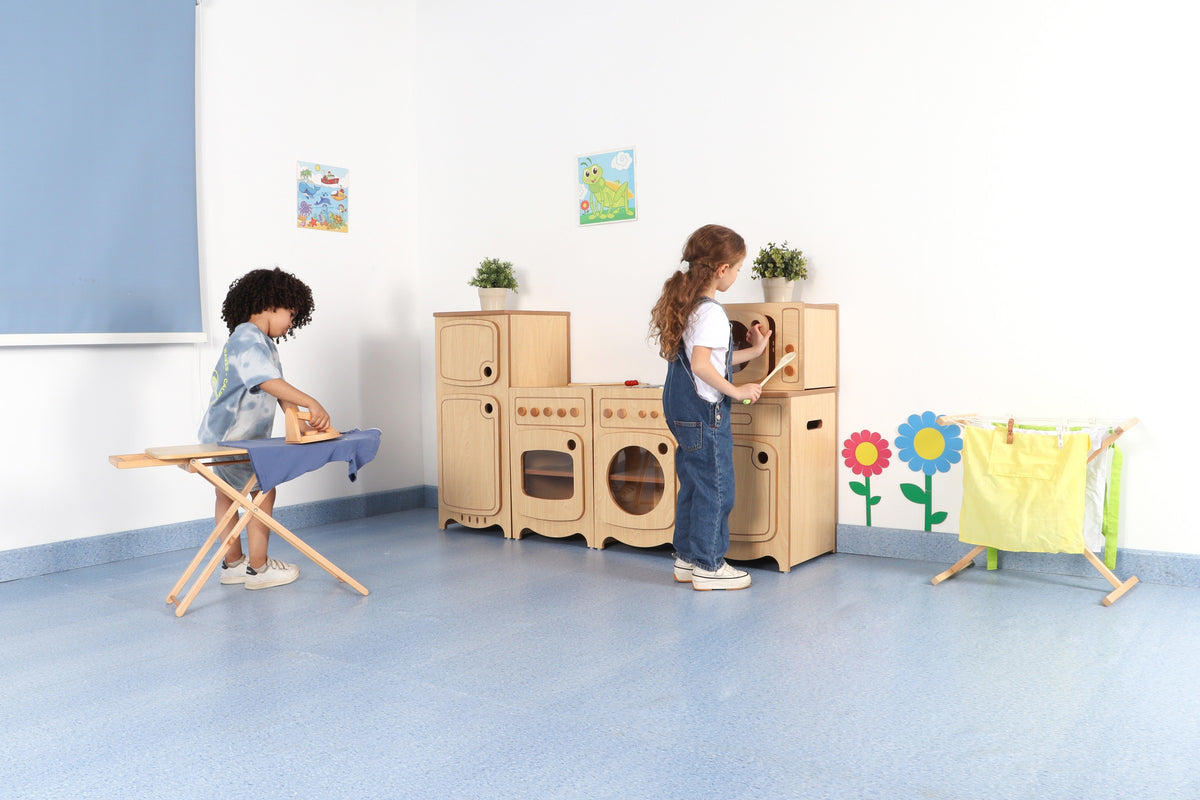
The short answer: A home corner is a role-play area set up like a real home: a child-sized kitchen, a table and chairs, dolls with a bed, dress-ups and real-looking props. Keep it simple and familiar for toddlers, then add more roles, props and writing materials for 3 to 5 year olds. Define it with low dividers, place it near blocks, and keep clear sightlines for supervision.
Key Points
- A home corner builds language, social skills, identity and early maths through everyday pretend play.
- Core pieces: a kitchen unit, a table and chairs at the right height, a doll bed, dress-ups and a mirror.
- Match the props to age: fewer and larger for toddlers, more varied and detailed for older children.
- Reflect the children's own families and cultures, so every child sees their home in the play.
- Rotate themes (café, shop, vet, doctor) to extend play once the home is familiar.
- Check play food sizes for under-3s, avoid long cords on dress-ups, and keep units stable.
What is a home corner and why does it matter?
A home corner is a dedicated role-play space that looks and works like a small home. Children cook, care for babies, set the table, dress up and act out the routines they know. It is one of the most used areas in any early learning room, and one of the richest for learning.
In the home corner, children practise:
- Language and communication. Children negotiate roles, explain what they are doing and use new words in context.
- Social skills. Sharing props, taking turns, solving disagreements and working towards a shared story.
- Identity and belonging. Acting out family life helps children make sense of their own home and see it valued at the centre.
- Emotional understanding. Caring for a doll or playing a parent lets children explore feelings and practise empathy.
- Early maths. Setting places at the table, matching cups to plates, counting spoons and sorting food.
- Early literacy. Writing shopping lists, reading recipe cards and making signs.
Under EYLF V2.0, home corner play supports several learning outcomes at once: a strong sense of identity, connection with and contribution to their world, and being effective communicators. The Australian Government Department of Education (education.gov.au) publishes the framework.
What should a home corner include?
A good home corner includes a kitchen unit, a table with chairs, a place to care for dolls, dress-ups with a mirror, and a basket of real-looking props. Start with these, then add detail as children show what interests them.
| Item | Why it matters | What to look for |
|---|---|---|
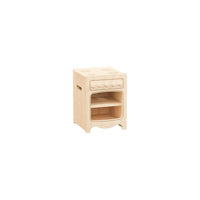
| Kitchen unit (stove, sink, cupboard) | The anchor of the space. Cooking is the most familiar home routine. | Solid, stable, at a comfortable standing height for the age group, with doors that open and close easily |
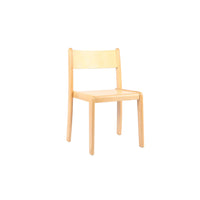
| Table and chairs | Meals, tea parties, writing lists, playing family | Chairs and table from the same size mark, matched to the children |
| Doll bed or cradle | Caring play, settling routines, empathy | Sturdy, low and big enough for a doll and blanket |
| Dolls | Caring roles, family stories | Different skin tones, genders and clothing, washable |
| Dress-up storage and mirror | Trying on roles, self-recognition | Low hooks or a low rack, and a securely fixed child-safe mirror |
| Kitchen props | Cooking, serving, sorting, counting | Pots, pans, utensils, plates, cups, play food suited to the age group |
| Literacy props | Lists, recipes, messages | Notepads, pencils, a phone, recipe cards, a calendar |
| Soft furnishings | Makes the space feel like a home | A small rug, a cushion, a cloth for the table, all washable |
Our role-play furniture includes kitchens and home corner pieces made for the daily use a busy room gives them.
What should be in a home corner for each age?
Toddlers need a simple, familiar home corner with a few large, sturdy props they can carry and use. Three to five year olds need more variety, more detail and materials that let them build longer stories and bring in writing and counting.
| Age | How children play | What to include |
|---|---|---|
| 1 to 2 years | Copying simple actions: stirring, feeding a doll, putting things in and out | A low kitchen, a few large pots and spoons, a soft doll, a doll bed, large play food that cannot be swallowed, a low mirror |
| 2 to 3 years | Short pretend sequences, parallel play, naming and talking about actions | Add plates and cups, a table and chairs, simple dress-ups (hats, bags, scarves), a phone, a few familiar foods |
| 3 to 4 years | Shared play, taking roles, longer stories with friends | Add more dress-ups, more varied food, a cash register or shopping basket, notepads and pencils, dolls with clothes to change |
| 4 to 5 years | Planned play with rules, roles and props they make themselves | Add recipe cards, menus, a calendar, loose parts to stand in for objects, materials to make signs and labels |

Where should the home corner go in the room?
Place the home corner in a defined corner of the room, enclosed on two or three sides by walls or low dividers, next to the block area and away from the book corner. That keeps lively talk away from quiet spaces and lets play flow between building and home.
- Next to blocks. Children often build a house, a car or a shop and carry home corner play into it. Placing them side by side encourages this.
- Away from quiet areas. Home corner play is busy and noisy. Keep it apart from reading and rest spaces.
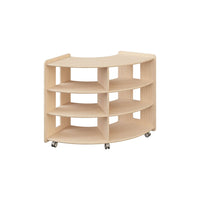
- Defined edges. Low storage units and dividers give the space a "room" feel while keeping it open to view.
- Open to supervision. Regulation 115 requires premises to be designed to facilitate supervision. Keep dividers low enough for educators to see in from anywhere in the room.
- Room for a small group. Plan space for several children to play together without crowding, plus floor space for dolls and dress-ups.
- Near natural light. A window nearby makes the space feel warm and homelike.
If you are planning a whole room, our EYLF learning environment guide covers how the areas fit together.
How do you make a home corner inclusive?
Make the home corner inclusive by filling it with things children recognise from their own homes. Ask families what they cook with, what they wear and what languages they speak at home, then reflect that in the props, dolls, clothing and print.
NQS Element 3.2.1 Inclusive environment asks services to organise spaces so every child can take part. In the home corner, that looks like:
- Cooking tools from different kitchens. A wok, a tagine, chopsticks, a tortilla press, a teapot. Choose what matches your families.
- Dolls that look like the children. A range of skin tones, hair types and clothing, and dolls of different genders.
- Clothing from many cultures. Scarves, wraps, hats and fabrics families can contribute or help choose.
- Home languages in print. Labels, recipe cards and food packaging in the languages your families use. Our Arabic toys and puzzles are one example of bringing a home language into play.
- Photos of real families. A small frame or a photo board of children's families at home makes the corner feel like theirs.
- Roles open to everyone. Every child cooks, cares for babies and goes to work. Avoid labelling props or roles by gender.
- Physical access. Check that a child using a walking frame or wheelchair can reach the table and kitchen, and that there is space to move.
How do you extend role play beyond the home?
Once children know the home corner well, extend play by turning it into a new setting for a few weeks: a café, a shop, a vet clinic, a doctor's surgery, a post office or a hairdresser. Follow the children's interests and real events in their lives, such as a new baby, a trip or a visit to the doctor.
- Watch first. Notice what children are already acting out. Interest in pets suggests a vet clinic. Talk about a new sibling suggests a baby clinic.
- Keep the anchor. The kitchen unit and table stay. A café still needs a kitchen; a shop still needs a counter.
- Add a few new props. Menus, aprons and order pads for a café. A cash register, baskets and price tags for a shop. Bandages, a clipboard and soft toy animals for a vet.
- Bring in print and numbers. Signs, price labels, appointment books and receipts build early literacy and maths naturally.
- Use real and recycled materials. Clean food packaging, paper bags and boxes are free, realistic and support NQS Element 3.2.3 Environmentally responsible.
- Return to the home. After a theme runs its course, set the home corner back up. The familiar space is comforting, especially for younger children.

What safety checks does a home corner need?
Check that every unit is stable, every prop is the right size for the youngest child in the room, dress-ups have no long cords, and mirrors are child-safe and fixed securely. Regulation 103 requires furniture, materials and equipment to be safe, clean and in good repair.
- Stable units. Kitchens and cupboards should not tip when a child leans on an open door or climbs. Anchor them if needed.
- Doors and hinges. Check for finger traps and loose hinges, especially on oven and cupboard doors.
- Small parts. Remove anything small enough to swallow from rooms with children under 3.
- Cords and straps. Remove long cords, drawstrings and ties from dress-ups and bags to reduce strangulation risk.
- Mirrors. Use child-safe mirrors fixed securely to a wall or unit.
- Real items. Real kitchen tools work well for older children, but leave out anything sharp, breakable or heavy that could cause harm, and supervise closely.
- Cleaning. Play food, dishes and dress-ups go in mouths and on heads. Wash them on a regular cycle and record it.
What furniture sizes suit a home corner?
Choose a home corner table and chairs from the same size mark as the rest of the room, matched to the children's age. Kitchen units should let children reach the stove top and sink comfortably while standing, without stretching on tiptoe.
| Size mark | Age | Seat height | Table height |
|---|---|---|---|
| C02 | 1 to 2 years | 17 cm | 36 cm |
| C0 | 2 to 3 years | 21 cm | 40 cm |
| C1 | 3 to 4 years | 26 cm | 46 cm |
| C2 | 4 to 6 years | 31 cm | 53 cm |
A seated child should have feet flat on the floor, knees at about 90 degrees and forearms resting just below elbow height on the table. Our size guide has the full chart, including sizes for older children and educators.
Home Corner Set-Up Checklist
- Defined space enclosed on two or three sides, with low dividers.
- Placed next to blocks and away from the book corner.
- Clear sightlines for educators from across the room.
- Stable kitchen unit at a comfortable height for the age group.
- Table and chairs from the same size mark, matched to the children.
- Doll bed, dolls of different skin tones and genders, and blankets.
- Dress-ups on low hooks, with no long cords or drawstrings.
- A child-safe mirror fixed securely.
- Props from the children's own cultures and home languages.
- Literacy and maths props for 3 to 5 year olds.
- No small parts in rooms with children under 3.
- A cleaning cycle for food, dishes and dress-ups.
- A plan for rotating themes through the year.
Plan Your Home Corner
Whether you are fitting out a new room or refreshing an old home corner, start with the space and the children. If you would like help, send us a floor plan and we will return a quote and 3D design within 24 hours showing the home corner in context. You can request a quote or browse our role-play range. If you are in Victoria, you are welcome to see the pieces at our Pakenham showroom by appointment.
Frequently Asked Questions
What is a home corner in early childhood?
A home corner is a role-play area in an early learning room set up like a small home, with a child-sized kitchen, table and chairs, dolls, a doll bed, dress-ups and everyday props. Children act out family routines, which builds language, social skills, early maths and a strong sense of identity. It is one of the most used areas in most rooms.
What should be in a home corner?
Include a stable kitchen unit, a table and chairs matched to the children's size, a doll bed with dolls of different skin tones, dress-ups on low hooks, a child-safe mirror and kitchen props such as pots, plates, cups and play food. For 3 to 5 year olds, add notepads, recipe cards and a phone to bring in writing and talking.
How do you set up a home corner for toddlers?
Keep it simple and familiar. Use a low kitchen, a few large pots and spoons, a soft doll and doll bed, large play food that cannot be swallowed, and a low mirror. Toddlers copy simple actions like stirring and feeding, so fewer props work better. Check every item is too large to be a choking hazard for children under 3.
Where should the home corner go in a room?
Place it in a defined corner, enclosed on two or three sides by walls or low dividers, next to the block area and away from the reading corner. Blocks and home corner play often flow together, while the noise is kept away from quiet spaces. Keep dividers low so educators can supervise from anywhere in the room.
How do you make a home corner culturally inclusive?
Ask families what they cook with, wear and speak at home, then reflect that in the space. Add cooking tools from different kitchens, dolls of different skin tones, fabrics and clothing from many cultures, labels and packaging in home languages, and photos of children's own families. Make every role open to every child, regardless of gender.
How often should you change the home corner?
There is no set rule. Many educators keep the home set-up as the base and turn it into a new theme, such as a café, shop or vet clinic, for a few weeks when children's interests point that way. Watch what children are acting out, change a few props at a time, and return to the familiar home in between themes.
What age is home corner play for?
Home corner play suits children from about 1 year through to school age. Toddlers copy simple actions such as stirring and feeding a doll. Three year olds start to take roles and play together. Four and five year olds plan longer stories with rules, and bring in writing, counting and props they make themselves.
Planning a room, or a whole centre?
Send us your floor plan. Within 24 hours you'll have an itemised quote, 2D room plans, a 3D showcase and a video walkthrough of your centre.
