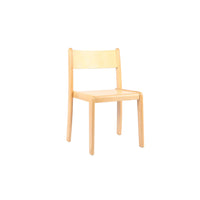




Kids table and chairs: the right height by age (size chart and fit check)
Kids table and chairs height by age: seat and table heights from 1 to 11 years, a 5-step fit check, arms vs no arms, wood vs plastic and growing sizes.
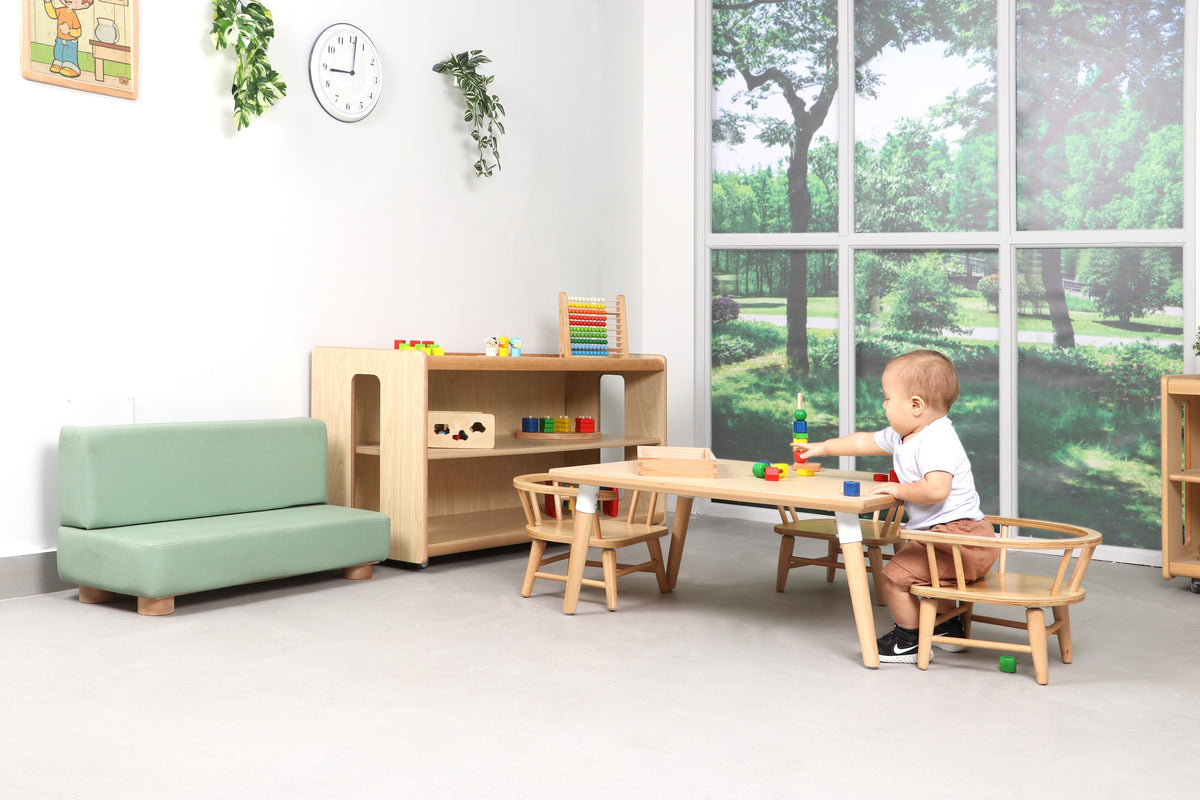
The short answer: Size kids table and chairs by your child's body, not the box. As a guide: 1 to 2 years, a 17 cm seat and 36 cm table; 2 to 3 years, 21 cm and 40 cm; 3 to 4 years, 26 cm and 46 cm; 4 to 6 years, 31 cm and 53 cm. Feet flat, knees about 90°, forearms resting on the table.
Key Points
- Seat height matters most: your child's feet should rest flat on the floor, not dangle.
- The table should sit just below elbow height when your child is seated, so forearms rest on it without shoulders lifting.
- Always pair a chair and table from the same size mark. A mismatched set undoes a good chair.
- Armless chairs suit most children from about 2. A chair with arms can help a new sitter feel secure.
- Solid wood is heavier and steadier than plastic, which matters for climbers and leaners.
- Children move up a size roughly every one to two years, so plan for growth from the start.
What height should a kids table and chair be?
A kids chair should let your child sit with feet flat and knees bent to about a right angle, and the table should sit a few centimetres below their elbow. The chart below is our size chart. It follows the BS EN 1729 size marks used for school furniture, plus two smaller sizes for babies and young toddlers.
| Size mark | Typical age | Seat height | Table height |
|---|---|---|---|
| C01 | 0–1 years (once sitting steadily) | 13 cm | 30 cm |
| C02 | 1–2 years | 17 cm | 36 cm |
| C0 | 2–3 years | 21 cm | 40 cm |
| C1 | 3–4 years | 26 cm | 46 cm |
| C2 | 4–6 years | 31 cm | 53 cm |
| C3 | 6–8 years | 35 cm | 59 cm |
| C4 | 8–11 years | 38 cm | 64 cm |
Ages are a starting point only. A tall two year old may already fit C1, and a smaller four year old may still be comfortable at C0. If you are buying for a classroom or comparing older sizes, our classroom table and chair heights reference covers the full range up to adult educators. You can also see every size side by side on our size guide.
How do I check if a kids chair fits my child?
Sit your child on the chair at the table, shoes off, and run through five quick checks. If all five pass, the set fits.
- Feet flat. Both feet rest flat on the floor. Dangling feet mean the seat is too high; your child will perch on the edge or slide around.
- Knees at about 90°. Thighs sit roughly level with the seat and knees bend to about a right angle. Knees pushed up above the hips mean the seat is too low.
- Forearms on the table. With shoulders relaxed, forearms rest on the tabletop just below elbow height. If shoulders hunch up, the table is too high. If your child slumps forward to reach, it is too low.
- Thigh clearance. There is space between the top of the thighs and the underside of the table, so your child can slide in and out without bumping.
- Same size mark. Chair and table come from the same size, so the gap between seat and tabletop is right.
Shopping online and can't test? Measure your child sitting on a low step or box with knees at a right angle. The distance from the floor to the crease behind the knee is roughly the highest seat that will still let their feet sit flat. Pick the size mark with a seat height at or just under that number.

Why does the right table and chair height matter?
A child who fits their chair can stop thinking about balance and put their attention into their hands. That is the whole point of child-height furniture.
- Stability frees the hands. When feet are planted and the trunk is supported, the arms and fingers can do fine work: drawing, puzzles, threading, eating with a spoon.
- Better drawing and early writing. A table at the right height lets the forearm rest and the wrist move freely. Too high, and children draw with a lifted shoulder and tire quickly. We cover this in our guide to pre-writing skills and letter tracing.
- Independence. A chair your child can climb onto, sit down on and leave without help means they can choose an activity and settle to it on their own.
- Longer, calmer sitting. Children who are not wriggling to stay on a seat tend to stay at a puzzle or a meal a little longer.
- Safety. A child perched on a too-high adult chair, or kneeling on a seat to reach a table, is far more likely to tip or fall.
What should I look for in a toddler table and chairs set?
For toddlers, look for a stable, heavy-enough set with rounded edges, a low seat they can climb onto, and a chair light enough for them to pull out but not easy to tip.
- Stability first. Toddlers lean, rock and climb. A wide stance and splayed or well-spaced legs make tipping much less likely. Press down on one corner of the table: it should not lift on the other side.
- Rounded corners and edges. Toddler foreheads sit right at table height. Rounded corners and softened edges matter more at 1 and 2 than at any other age.
- The right weight. Your child should be able to slide their own chair out and in. Too light and it skates away or tips when they lean back; too heavy and they will need you every time.
- No pinch points or loose parts. Avoid folding mechanisms, gaps where fingers can be trapped, and small caps or screws that could work loose. For children under three, anything that can come off and fit in a mouth is a choking hazard.
- A durable, wipeable finish. Food, paint and playdough all end up on the table. A sealed surface that wipes clean with a damp cloth saves a lot of scrubbing.
- A surface big enough to work on. As a rough test, an A3 sheet of paper plus a pot of crayons should fit comfortably in front of each seat.
Should a kids chair have arms or no arms?
For most children from about 2 years, an armless chair is the better choice. For a new sitter around 1, a chair with arms or a supportive tub shape can help them feel secure.
| Chair with arms | Armless chair | |
|---|---|---|
| Best age | New sitters, roughly 9 months to 2 years | Most children from about 2 years |
| Strengths | Feels enclosed and secure; arms help children push up to stand | Easy to slide on and off; tucks under the table; elbows free for drawing |
| Watch for | Arms that hit the table edge and stop the chair tucking in | A seat that is too wide or slippery for a small child |
The deciding question is whether the chair lets your child get close enough to the table. If the arms catch on the tabletop, your child ends up sitting too far back and leaning forward, which defeats the purpose of choosing the right height.
Is a wooden or plastic kids table better?
Both can work. Solid wood is heavier, steadier and lasts for years. Plastic is light and cheap but tips more easily and rarely outlives the first child.
| Material | Good for | Trade-offs |
|---|---|---|
| Solid wood | Stability, durability, repairability; can be lightly sanded and refinished | Heavier to move; costs more up front |
| Plywood | Strong and stable; good for tabletops | Edges need to be well sealed and rounded |
| MDF or particleboard | Lower cost; smooth painted finish | Edges can chip and swell if they get wet; harder to repair |
| Plastic | Very light; easy to wipe; outdoor use | Tips and slides more easily; can crack; looks worn sooner |
Whatever the material, ask what finish is used and whether it is suitable for children's furniture. Children chew, lick and lean on everything at this age. A good set should also come with a clear warranty. All our furniture carries a 5-year warranty.
Where should the kids table go at home?
Put it where your child already wants to be: usually in or near the main living area, with good daylight and a low shelf close by.
- Near you. Toddlers rarely play alone in a back bedroom. A table in sight of the kitchen or lounge gets used far more.
- On a firm floor. Chair legs wobble on thick rugs. A hard floor or a flat, low-pile rug keeps the set steady.
- Room to move. Leave enough space behind the chair for your child to pull it out and stand up without hitting a wall or furniture.
- Next to a low shelf. A few activities on a shelf beside the table lets your child choose, carry and return them. See our guide to setting up a Montessori shelf and rotating toys.
- Good light. Natural light from the side is ideal for drawing and puzzles.
Short on space? Our guide to playroom ideas for small spaces shows how to fit a table, shelf and book spot into a corner of a living room.
How long will a kids table and chairs set last?
A well-made set will last for many years, but your child will outgrow its height long before it wears out, usually within one to two years per size.
Looking at the chart, the seat height rises by 4 to 5 cm with each size mark from 1 to 6 years. That sounds small, but it is the difference between feet flat and feet dangling, or between a relaxed shoulder and a hunched one. Signs your child has outgrown their set:
- Knees rise noticeably above the hips when seated.
- Thighs touch or press against the underside of the table.
- They hunch or round their back to bring their arms down to the tabletop.
- They start choosing the couch or kneeling on an adult chair instead.
You have three realistic options. You can buy a new set each time, buy a height-adjustable table and accept that the chair still needs replacing, or join a plan that sends the next size as your child grows, so the old set stays with you.
That last option is why we started Chapters. For $149 every 3 months (GST and delivery included), your child gets a solid-wood table and chair at their height to keep, and we send the next chair and table legs free as they grow. Each quarter also brings a new chapter of wooden toys for their age, with a printed play guide. You can cancel any time, and the furniture is yours to keep. Members get 15% off everything in the shop. You can also pay $499 for the year upfront instead of quarterly.
Getting the Right Size First Time
If you only remember one thing, remember feet flat and forearms resting. Measure, check the size mark, and buy the chair and table together. Our size guide has the full chart. If you would rather not keep track of sizes yourself, see how Chapters works, or browse our home furniture, tables and chairs.
Frequently Asked Questions
What height table does a 2 year old need?
Most 2 year olds fit a table about 40 cm high with a chair seat about 21 cm high. That is our C0 size mark, for roughly 2 to 3 years. Check the fit with your child seated: feet flat on the floor, knees bent to about 90°, and forearms resting on the tabletop just below elbow height. A tall 2 year old may already need the next size.
What size chair does a 1 year old need?
A child aged 1 to 2 usually fits a chair with a seat about 17 cm high, paired with a table about 36 cm high. Only offer a chair once your child can sit steadily on their own. At this age a chair with arms or a supportive shape can help them feel secure, as long as it still lets them sit close to the table.
How do I measure my child for a kids chair?
Sit your child on a low step or box with knees at a right angle and feet flat, shoes off. Measure from the floor to the crease behind the knee. That number is roughly the highest seat that will still let their feet rest flat. Choose a size with a seat height at or just under it, then pick the matching table.
Can a 4 year old and a 2 year old share one table?
They can, but it will not fit both properly. A 2 year old suits a table about 40 cm high, while a 4 year old suits one about 53 cm high. If they must share, size the table for whoever uses it most and give each child a chair from their own size. Separate small sets are the better long-term answer.
Are chairs with arms better for toddlers?
For new sitters, around 1 year, arms or a tub-shaped chair can feel secure and help them push up to stand. From about 2, armless chairs usually work better: they are easier to get on and off, tuck under the table, and leave elbows free for drawing. Whichever you choose, make sure the arms do not stop the chair sliding close to the table.
Is solid wood furniture safe for toddlers?
Well-made solid wood furniture is a good choice for toddlers because it is heavy and stable, so it is harder to tip. Look for rounded corners, smooth sanded edges, no small parts that could come loose, and a finish suitable for children's furniture. Check Product Safety Australia for any recalls on the product before you buy.
How often will my child need a bigger table and chair?
Most children move up a size roughly every one to two years between ages 1 and 6, as seat heights step up by about 4 to 5 cm per size. Signs it is time: knees above hips, thighs touching the underside of the table, or hunching to reach the tabletop. A plan such as Chapters sends the next size as your child grows, so you don't have to keep track.
Do kids tables need to match the chair?
Yes. The gap between seat and tabletop is what lets forearms rest comfortably, so a chair and table should come from the same size mark. A well-fitted chair at a table that is too high still leaves your child with lifted shoulders, and a low table makes them slump. Buy them as a set, or check both heights against a size chart.
A table, a chair, and a new chapter of play.
Chapters: a solid-wood table and chair at their height, with the next size sent as they grow, and a new box of wooden toys for their age every 3 months.
