



Montessori shelf and toy rotation: how to set up and how often to swap
How to set up a Montessori shelf at home: the right height, how many toys by age, using trays, and a simple toy rotation rhythm with a sample 4-week plan.
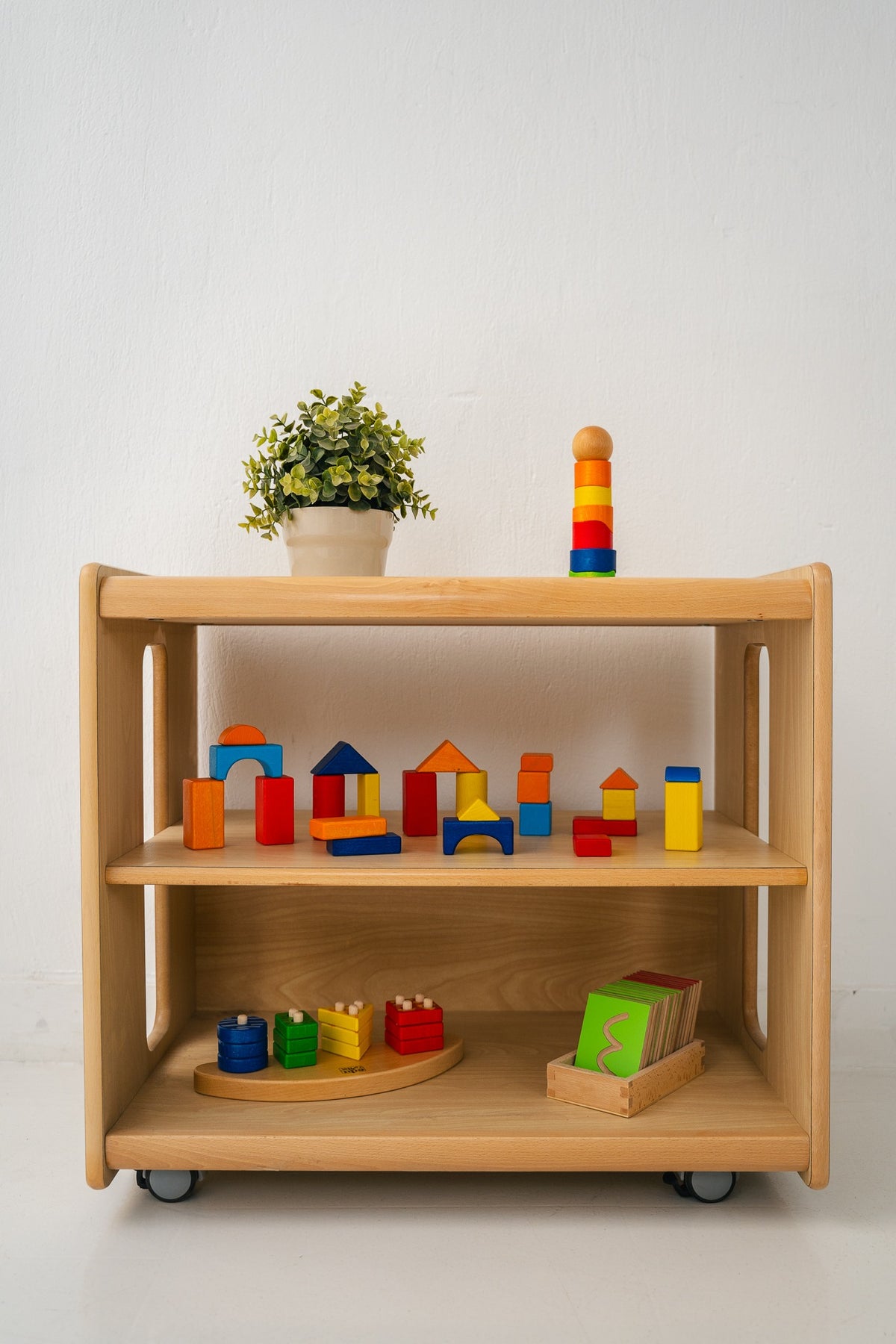
The short answer: A Montessori shelf is a low, open shelf your child can see and reach without help, holding a small number of activities, each in its own place. Start with about 6 to 8 activities for a toddler and 8 to 12 for a preschooler. Store the rest and rotate a few every one to two weeks, guided by what your child is actually using.
Key Points
- Keep the shelf low: your child should see and reach the top without climbing.
- Fewer toys, clearly displayed, lead to longer and calmer play than a full toy box.
- Give every activity its own spot, ideally on a tray or in a basket, with space around it.
- Rotate a few items at a time, not the whole shelf, and keep current favourites out.
- Anchor every shelf to the wall, however low it is.
What is a Montessori shelf?
A Montessori shelf is a low, open shelf that displays a few toys and activities where a child can choose them, use them and put them back on their own. It is one part of what Montessori educators call the prepared environment: a space set up so children can be independent.
It differs from a toy box in three ways:
- Everything is visible. Children can see each option rather than digging through a pile.
- Everything has a place. Each activity returns to the same spot, so tidying up is simple and children learn order.
- There is less of it. A deliberately small selection, changed over time.
You do not need a special "Montessori" shelf. Any sturdy, low, open shelf works if it is the right height and safely anchored.
How high should a Montessori shelf be?
The top shelf should be at or below your child's chest height, so they can see and reach everything without climbing or stretching. In practice, that means a shelf with two or three tiers.
| Age | What works | Why |
|---|---|---|
| Crawlers and cruisers (about 8–14 months) | One or two tiers, very low; or a low ledge at floor level | Babies pull up on furniture, so it must be stable and anchored |
| Toddlers (about 1–3 years) | Two tiers, top shelf around waist to chest height | They can see the top surface and carry trays off it safely |
| Preschoolers (about 3–5 years) | Two or three tiers | Taller children can reach a third tier; more room for longer projects |
A useful test: stand your child beside the shelf. If they can see the back of the top shelf and lift a tray off it with both hands, the height is right.
How many toys should be on a Montessori shelf?
Usually between 6 and 12 activities, depending on age. Younger children need fewer.
| Age | Activities on the shelf | Plus |
|---|---|---|
| Under 1 | 3–5 | A treasure basket and a few board books |
| 1–2 years | 6–8 | A book basket with 4–6 books |
| 2–3 years | 8–10 | Books, plus a practical life tray such as pouring |
| 3–5 years | 10–12 | Books, art materials, and a space for ongoing projects |
These numbers are a starting point. Watch your child for a week. If the shelf looks untouched and they wander, there may be too much, or too little of interest. If they tip things out and move on quickly, reduce the number. If they finish everything and look for more, add one or two harder activities.
Not sure which toys to start with? Our guide to Montessori toys by age has lists for 1, 2, 3 and 4 to 5 year olds.
How do I set up a Montessori shelf?
Set it up so that every activity is complete, easy to see, and has its own spot, with a mix of skills across the shelf.
- Choose a spot. In the room where your child spends most of their day, ideally beside a child-height table and a rug or play mat for floor work.
- Clear it completely. Start from an empty shelf so you are choosing, not just tidying.
- Pick a balance of activities. Aim for a mix: something for the hands (fine motor), a puzzle, something to sort or match, something to build, a practical life task, and books.
- Put each activity on its own tray or in its own basket. This marks where it starts and ends and makes it easy to carry.
- Leave space between items. A crowded shelf is hard to read. Clear gaps help children see each choice.
- Arrange from easier to harder. Many families arrange left to right, which also mirrors the direction of reading English.
- Keep it complete. Every piece present. A puzzle missing one piece is a frustration, not an activity.
- Show, then step back. When something new goes on the shelf, show your child once, slowly, with few words. Then let them try.

Why do trays help on a Montessori shelf?
A tray turns a pile of pieces into a single, self-contained activity. It tells your child what belongs together, where the activity starts and finishes, and where it goes back.
- Clear boundaries. Beads stay on the tray rather than across the floor.
- Easy to carry. Children can lift the whole activity to a table or mat, which builds coordination and care.
- Simple tidy-up. When the tray is full again, the job is done.
- Calm display. A row of trays looks orderly, which helps children choose.
Choose trays that are light enough for your child to carry with two hands, with low raised edges so pieces don't roll off. Wooden trays are sturdy and easy to wipe. Small baskets work well for soft or bulky items. Our range includes Montessori-style trays for this.
What is toy rotation?
Toy rotation means keeping most of your child's toys stored away and putting out a small selection at a time, swapping some every so often.
Families who rotate usually notice a few things:
- Toys feel new again. A puzzle that has been away for a month often gets far more attention when it returns.
- Play goes deeper. With fewer choices, children tend to stay with one activity longer.
- Tidying is easier. Eight things are easier to put back than eighty.
- You see what your child needs. A small shelf makes it obvious what is being used, what is too easy and what is too hard.
- You buy less. A rotated collection goes further than a constantly growing one.
How often should you rotate toys?
Every one to two weeks suits most toddlers and preschoolers, swapping two or three items at a time. Let your child's interest set the pace, not the calendar.
Signs an item is ready to rotate out:
- It has sat untouched for several days.
- Your child completes it quickly every time with no challenge left.
- It is being used for throwing or banging rather than its purpose (a sign it is too easy or too hard).
Signs to leave an item out:
- Your child returns to it daily.
- They are still working at it, even with some frustration.
- They are using it in new ways.
Never rotate everything at once. Children find comfort in familiar things, and a shelf that changes completely overnight can be unsettling. Keep firm favourites out as long as they are loved.
| Week | Example shelf for a 2 year old (rotate 2–3 items each time) |
|---|---|
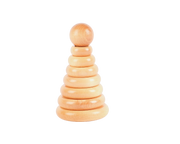
| Week 1 | Stacking rings, shape sorter, knobbed farm puzzle, large bead threading, pouring tray, stacking cubes, book basket |
| Week 2 | Stacking rings, nut-and-bolt board, knobbed farm puzzle, large bead threading, pouring tray, sorting box, book basket (new books) |
| Week 3 | Stacking rings, nut-and-bolt board, vehicle puzzle, playdough tray, pouring tray, sorting box, book basket |
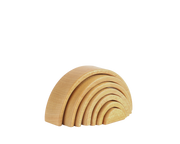
| Week 4 | Building arch and blocks, nut-and-bolt board, vehicle puzzle, playdough tray, spooning tray, sorting box, book basket (new books) |
Items in italics are the ones swapped in that week.
Where should I store toys that are not on the shelf?
Out of sight and out of reach, in closed storage, grouped so you can find the next thing quickly.
- Use closed tubs or a high cupboard. If your child can see stored toys, they will ask for them, and the rotation stops working.
- Group by type or skill. Puzzles together, fine motor together, building together. This makes it easy to keep a balanced shelf.
- Label the tubs. A word or photo on each one saves time.
- Keep sets complete. Use zip bags or small boxes for loose pieces so nothing goes missing between rotations.
- Do a quick check when you rotate. Look for cracks, splinters, loose parts and worn finishes, and wipe toys clean before they go back out.
Short on space? Our guide to playroom ideas for small spaces covers storage that fits a living room or bedroom corner, and our storage units are worth a look if you need more.
What are common Montessori shelf mistakes?
Most problems come from putting out too much, or the wrong level of challenge.
- Too many toys. A crowded shelf leads to tipping out and wandering. Halve it and watch what changes.
- A shelf that is too tall. If your child has to climb or stretch, it is not their shelf. Use the top for display only, or choose a lower unit.
- Incomplete sets. Missing pieces make a toy unusable. Check when you rotate.
- Everything at the same level. Include one or two activities that are a little hard. That is where concentration grows.
- Nowhere to work. A shelf works best beside a child-height table or a defined floor mat. See our guide to kids table and chair heights by age.
- Rotating for the sake of it. If your child loves something, leave it out.
Getting Started This Week
Clear one low shelf, choose six to eight activities, put each on a tray or in a basket, and store the rest. Watch for a week, then swap two or three. That is the whole method.
If you would like rotation built in, Chapters sends a new box of wooden toys chosen for your child's age every 3 months, with a printed play guide, plus a solid-wood table and chair at their height, with the next size sent as they grow and yours to keep. Members also get 15% off the whole shop.
Frequently Asked Questions
How many toys should be on a Montessori shelf?
For a 1 to 2 year old, about 6 to 8 activities is plenty. Two to three year olds can manage 8 to 10, and 3 to 5 year olds 10 to 12, plus a small book basket. Fewer toys on display usually lead to longer, calmer play. Watch how your child uses the shelf and adjust the number up or down.
How often should I rotate my toddler's toys?
Every one to two weeks works for most toddlers, swapping two or three items at a time rather than the whole shelf. Rotate out toys that sit untouched, are now too easy, or are being thrown instead of used. Keep favourites out for as long as your child keeps returning to them.
What height should a Montessori shelf be?
The top of the shelf should be at or below your child's chest height, so they can see and reach every item without climbing. For most toddlers and preschoolers that means a two-tier or three-tier low shelf. Whatever the height, anchor it securely to the wall, because young children pull up on and climb furniture.
Do I need a special Montessori shelf?
No. Any sturdy, low, open shelf can be a Montessori shelf if your child can see and reach everything on it, it is anchored to the wall, and it holds a small number of activities with space between them. What matters is the height, stability and how you use it, not the label.
What should go on a Montessori shelf for a 1 year old?
For a 1 year old, try a posting box, an object permanence box, large stacking rings, nesting cups, a one-piece knobbed puzzle, a treasure basket of safe household objects and a few board books. Keep every piece too large to swallow, since children under 3 mouth objects, and supervise play with anything small.
Where do I keep toys that are rotated out?
Store them out of sight and out of reach, in closed tubs or a high cupboard, grouped by type such as puzzles, building and fine motor. Label each tub. If your child can see stored toys, they will ask for them, which defeats the purpose. Check toys for damage and clean them before they return to the shelf.
Does toy rotation work for older children?
Yes. Preschoolers and early school-age children also play longer with a smaller, well-chosen selection. With older children, involve them in the rotation: let them choose what comes out and what goes away. Keep space for long-running projects, such as a block city or a drawing series, that should stay out for longer.
A table, a chair, and a new chapter of play.
Chapters: a solid-wood table and chair at their height, with the next size sent as they grow, and a new box of wooden toys for their age every 3 months.
