



Montessori toys by age: what to choose for 1, 2, 3, 4 and 5 year olds
Montessori toys by age: what makes a toy Montessori, the best choices for 1, 2, 3 and 4 to 5 year olds, and why not every wooden toy is Montessori.

The short answer: Montessori toys are simple, realistic toys, usually made of natural materials, that each focus on one skill a child can practise alone. Good choices: posting boxes and stacking rings at 1; shape sorters, knobbed puzzles and nuts and bolts at 2; sorting, threading and tracing at 3; counting, letters and fractions at 4 to 5. Not every wooden toy is Montessori.
Key Points
- A Montessori toy isolates one skill, is grounded in reality, and lets the child see their own mistakes.
- "Montessori" on a box is a description, not a certification. Judge the toy, not the label.
- Plenty of wooden toys are good, useful toys without being Montessori. That is fine.
- Fewer toys, set out on a low shelf, matter more than buying a full Montessori range.
- Everyday "practical life" tasks such as pouring, wiping and dressing are as Montessori as any toy.
- For children under 3, check every toy for small parts that could be a choking hazard.
What makes a toy Montessori?
A Montessori toy is one that fits the way Montessori education works: a child chooses it, works with it independently, and learns one clear thing from it. The approach comes from Dr Maria Montessori, an Italian doctor and educator who opened her first school for young children in Rome in 1907. She designed many of the classic materials still used in Montessori classrooms today.
Most toys sold as Montessori share these traits:
- One skill at a time. A posting box teaches posting. A knobbed puzzle teaches fitting one shape. The toy does not try to teach colours, numbers, animals and sounds all at once.
- Control of error. The toy shows the child when something is not right, without an adult stepping in. A ring that is too big will not sit on the peg properly; a cylinder in the wrong hole will not go in.
- Grounded in reality. Real objects, realistic animals, real tools sized for small hands. Montessori classrooms favour reality over fantasy for very young children.
- Child-led. The child does the work. No buttons that do the playing for them, no flashing lights, no songs that start on their own.
- Natural, honest materials. Wood, metal, cotton, wool and glass (for older children, with care). These have weight, temperature and texture that plastic usually lacks.
- Simple and beautiful. Calm colours and clean design, so the purpose of the toy is obvious.
- Complete. All pieces present, so the child can finish the task.
Are all wooden toys Montessori?
No. Wood is common in Montessori materials, but a toy is not Montessori just because it is made of wood.
A wooden fairy castle, a wooden dragon or a wooden toy with a dozen different activities on it can all be good toys. They are just not Montessori in the strict sense, because they lean on fantasy or mix many skills together. On the other hand, a plain set of stacking cups made of other materials may follow Montessori ideas closely.
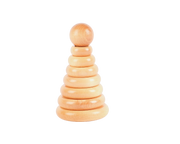
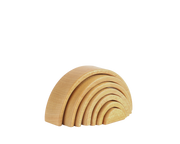
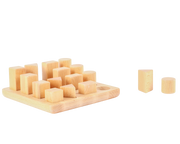
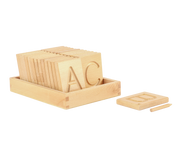
We make natural wooden toys, so we will be straight about this. Some of our toys follow Montessori principles closely: stacking rings, nut-and-bolt boards, sorting boxes, shape cups, trace-me letter boards and Montessori-style trays. Others, such as our building arches and role-play kitchens, are open-ended toys that sit happily alongside Montessori materials without being Montessori themselves. A good home playroom usually has both. If you want the wider case for wood, our guide to choosing wooden toys covers safety, finishes and care.
What are the best Montessori toys for a 1 year old?
For 1 year olds, choose toys that let them grasp, release, post, stack and discover that things still exist when hidden. Keep pieces large and the tasks simple.
- Object permanence box. A ball goes into a hole, disappears, then rolls out a tray. It answers the question "where did it go?" again and again.
- Posting box or coin box. Large shapes or chunky discs posted through a slot. It builds grip, release and hand-eye coordination.
- Stacking rings on a straight peg. Start with three or four large rings. Order does not matter yet; getting a ring on the peg does.
- Grading or stacking towers and nesting cups. Fitting, stacking and knocking down. All three are learning.
- Single-shape puzzles with large knobs. One or two pieces only to begin with.
- Treasure basket. A low basket of safe, real household objects in different textures: a wooden spoon, a soft brush, a large metal lid.
- Push toy or walker wagon. For cruising and first steps, choose one with a wide base that is hard to tip.
For a wider list, including non-Montessori favourites, see our guide to toys for one year olds.
What are the best Montessori toys for a 2 year old?
At 2, children want to fit, sort, twist and copy what adults do. Choose toys with a clear task and a little more challenge.
- Shape sorters with three to five shapes. Circle, square and triangle first, then more.
- Knobbed puzzles with several pieces. Animals, vehicles or everyday objects, each piece in its own space.
- Nut-and-bolt boards. Twisting a large wooden nut onto a bolt builds wrist rotation and concentration.
- Stacking rings in order of size. Now the order starts to matter, and a ring in the wrong place looks wrong.
- Large bead threading. Big wooden beads on a stiff lace or dowel.
- Simple matching. Matching real objects to pictures, or pairs of identical cards.
- Practical life. A small jug for pouring water, a child-sized dustpan and brush, a cloth for wiping the table.
Our guide to toys for two year olds has more ideas, and stacking toys and shape sorters explains how those two classics develop over time.
What are the best Montessori toys for a 3 year old?
Three year olds are ready for sorting by colour, size and shape, longer sequences, more precise hand work and the first steps toward letters and numbers.
- Sorting boxes and trays. Sorting by colour, then by shape, then by size.
- Graded cylinders or size sequences. Putting items in order from biggest to smallest trains careful looking.
- Threading and lacing. Smaller beads, lacing cards, simple patterns.
- Layered body puzzles and multi-piece puzzles. Puzzles that show how things are built, layer by layer.
- Trace-me letter and number boards. Tracing grooves with a finger introduces the shape and direction of letters before pencils.
- 1 to 10 stacking rings or counting pegs. Early counting with something to hold.
- Dressing and food preparation. Buttoning, zipping, spreading, peeling a mandarin, cutting a banana with a child-safe knife.
More options are in our guide to toys for three year olds.
What are the best Montessori toys for 4 and 5 year olds?
At 4 and 5, Montessori materials move into early maths, language and more complex construction. Children can work for longer and like a real challenge.
- Counting abacus and number puzzles. Counting objects, matching quantity to numeral, early addition.
- Fraction cups or fraction circles. Seeing that two halves make a whole, long before the word "fraction" means anything.
- Letter boards and movable letters. Tracing, then building simple words from sounds.
- Pattern and design work. Pattern blocks, wooden shapes strips, copying and extending designs.
- Construction with more pieces. Larger block sets and building arches for planned structures.
- Real tools. Child-sized gardening tools, a small hammer and golf tees in foam, cooking with an adult.
Families raising children in two languages often add letter and number puzzles in a second language at this stage. Our Arabic letter and number puzzles start from age 3. Our guide to toys for four year olds has more ideas.
Montessori Toys by Age: Quick Reference
Here is the whole progression at a glance. Ages are typical, not fixed. Follow your child.
| Age | Main focus | Toy examples | Practical life at home |
|---|---|---|---|
| 12–18 months | Grasp, release, object permanence | Object permanence box, posting box, treasure basket | Putting toys back in a basket, holding a cup |
| 18–24 months | Stacking, fitting, first puzzles | Stacking rings, nesting cups, one-piece knobbed puzzles | Carrying a napkin to the table, wiping spills |
| 2–3 years | Sorting, twisting, matching | Shape sorter, nut-and-bolt board, large bead threading | Pouring water, sweeping, washing hands alone |
| 3–4 years | Order, size, early letters | Sorting box, layered puzzles, trace-me letter boards | Buttoning, spreading, setting the table |
| 4–5 years | Counting, fractions, words | Counting abacus, fraction cups, movable letters | Cutting soft food, watering plants, folding washing |
How many Montessori toys does a child need?
Fewer than you think. Six to ten activities on a low shelf is plenty for a toddler, with the rest stored away and swapped in over time.
Montessori homes and classrooms keep toys visible and reachable, but limited. A child faced with forty toys tends to tip them all out and move on. A child faced with eight well-chosen ones tends to pick one, finish it and put it back. That is where concentration comes from.
Rotating toys every week or two keeps the shelf fresh without buying more. Our guide to setting up a Montessori shelf and rotating toys explains how many to put out at each age and how to decide what to swap.

How do I choose a good Montessori toy?
Ask a few quick questions before you buy. If the answer to most is yes, it is a good choice, whatever the label says.
- Does it teach one clear thing? You should be able to say in a few words what your child will practise.
- Can my child do it without me? After a short demonstration, they should be able to work alone.
- Will it show them a mistake? Good materials guide the child back to the right answer on their own.
- Is it the right challenge? Slightly hard is ideal. Too easy is boring; far too hard is frustrating.
- Is it well made and safe? Smooth edges, a child-safe finish, no small parts under 3, nothing loose or splintering.
- Is it complete and easy to tidy? A tray or box with a place for every piece helps children put it away.
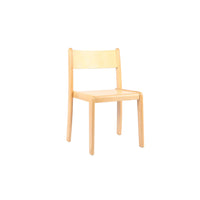
And remember the child-sized furniture. A Montessori toy works best at a table where your child's feet sit flat and arms rest comfortably. See our guide to kids table and chair heights by age.
Where to Start
You do not need a full Montessori range. Pick two or three toys that match what your child is trying to do right now, set them on a low shelf, and watch. If you would like this done for you, Chapters sends a new box of wooden toys chosen for your child's age every 3 months, with a printed play guide, plus a solid-wood table and chair at their height to keep, with the next size sent as they grow. Or browse our natural wooden toys and Montessori-style trays.
Frequently Asked Questions
What age are Montessori toys for?
Montessori toys exist for every age from babies to school age, but most toys sold under the name suit children from about 6 months to 6 years. Babies start with grasping toys and treasure baskets, toddlers move to posting, stacking and puzzles, and preschoolers move to sorting, tracing letters, counting and fractions. Choose by your child's skills, not only their age.
What is the difference between Montessori toys and regular toys?
Montessori toys focus on one skill, are grounded in reality, let the child spot their own mistakes, and are designed for independent work. Regular toys often combine many features, lean on fantasy or characters, and may use lights and sounds that do the playing for the child. Both have a place at home, but Montessori toys are built for concentration.
Are Montessori toys worth it?
A few well-chosen Montessori-style toys are worth it because they are simple, durable and match clear stages of development, so they get used for months. You do not need a whole range or the most expensive brand. A low shelf, a small number of good toys and everyday tasks such as pouring and wiping give most of the benefit.
What Montessori toys should a 1 year old have?
Good Montessori toys for a 1 year old include an object permanence box, a posting box, large stacking rings on a peg, nesting cups, a one-piece knobbed puzzle and a treasure basket of safe household objects. Keep every piece too big to swallow, since children under 3 mouth everything, and supervise play with any loose items.
Are wooden toys automatically Montessori?
No. Wood is common in Montessori materials, but a wooden toy is only Montessori in spirit if it isolates one skill, is grounded in reality and supports independent work. A wooden fairy castle or a busy multi-activity cube can be a good toy without being Montessori. Judge the design of the toy, not the material or the label.
How many toys should a Montessori toddler have out?
Around six to ten activities on a low, open shelf is plenty for a toddler. Store the rest out of sight and swap a few every week or two based on what your child is using, ignoring or has mastered. Fewer toys on display usually means longer, calmer play and easier tidy-up.
Can I do Montessori at home without buying special toys?
Yes. Much of Montessori at home is about the environment and everyday tasks: a low shelf, a child-height table and chair, a small jug for pouring, a cloth for wiping, hooks your child can reach. Real household objects in a treasure basket, sorting cutlery and helping in the kitchen all follow Montessori principles without special toys.
A table, a chair, and a new chapter of play.
Chapters: a solid-wood table and chair at their height, with the next size sent as they grow, and a new box of wooden toys for their age every 3 months.
