



Stacking toys and shape sorters: what they teach and when
Stacking toys and shape sorters by age: what they teach, when babies start stacking and sorting, how to play, which to choose first and what comes next.

The short answer: Stacking toys and shape sorters build hand-eye coordination, grip, problem solving and early maths ideas like size, shape and order. Babies usually start by knocking towers down and pulling rings off in the second half of the first year. Most toddlers stack and post simple shapes between 1 and 2, then move on to size order and multi-shape sorters between 2 and 3.
Key Points
- Taking apart comes before putting together: knocking down and pulling off are real first steps.
- Start with a few large pieces and one or two shapes, then add more as skills grow.
- A circle is the easiest shape to post, because it fits whichever way it turns.
- Show slowly, then step back: let the child try, fail and try again.
- The same toys later teach counting, sorting by colour and comparing sizes.
- For under-3s, every piece should be too big to swallow.
What do stacking toys teach?
Stacking toys teach children to control their hands, judge size and balance, and solve small problems by trial and error. Later, the same toys introduce counting, ordering and comparing.
When a toddler stacks rings onto a post or builds a tower of cubes, a lot is happening at once:
- Hand-eye coordination. Lining a ring up with the post, or one cube on top of another, takes careful aim.
- Grip and release. Letting go gently, at exactly the right moment, is harder than it looks. Early towers fall because the release is clumsy, not because the child doesn't understand.
- Size and order. Through handling, children notice that some rings are bigger, and that a big one on top of a small one wobbles. This is the start of seriation, putting things in order, which underpins later maths.
- Balance and cause and effect. Every tower that falls is a small physics lesson.
- Persistence. A child who tries a ring three ways before it fits is practising patience and problem solving.
- Language. Stacking gives you natural words to use together: big, little, on, off, up, down, more, again, fall.
What does a shape sorter teach?
A shape sorter teaches children to recognise shapes, match a shape to its hole, and turn an object in their hand until it fits. That turning, called rotation, is an early spatial skill.
A toddler's first attempts at a shape sorter are usually pushing hard and hoping. Over weeks, you will see them pause, look at the hole, look at the block and turn it. That pause is the learning. Shape sorters also build:
- Visual discrimination: noticing that a square and a triangle are different, even when they are the same colour.
- Object permanence and posting: the shape disappears inside and comes back when the lid opens, which delights children around their first birthday.
- Fine motor control: aligning edges precisely, especially with stars, crosses and other tricky shapes later on.
- Shape names: circle, square, triangle, rectangle, then less common shapes as they get older.
At what age do babies start stacking and sorting?
Most babies begin by taking things apart, knocking towers over and pulling rings off, in the second half of their first year. Stacking and posting usually follow after the first birthday, and sorting by size and several shapes comes between 2 and 3. Every child moves at their own pace.
| Age (roughly) | What you might see | Toys that fit | How to help |
|---|---|---|---|
| 6 to 12 months | Mouthing rings, banging blocks together, knocking down towers you build, pulling rings off a post, dropping things into a container | Large soft-edged blocks, chunky stacking rings, an open box or basket to drop things into | Build towers for them to knock down. Let them pull rings off. Name what happens: "Down." |
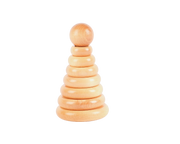
| 12 to 18 months | Putting rings back on in any order, stacking two or three blocks, posting a circle or a ball, filling and tipping | Stacking rings on a post, a posting box with one or two shapes, shape cups that nest | Offer fewer pieces. Show one move slowly, then hand it over |
| 18 months to 2 years | Taller towers, nesting cups, posting two or three shapes with some turning, lots of repetition | Nesting cups, stacking cubes, a sorting box with circle, square and triangle | Talk about big and little. Let towers fall without rushing in |
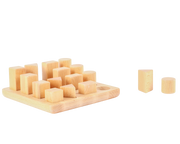
| 2 to 3 years | Putting rings or cups in size order with some trial and error, sorting several shapes, matching colours | Grading towers, stacking cubes, a multi-shape sorting box, wooden shapes strips | Ask "Which one is biggest?" Mix sorting by colour and by shape |
| 3 to 5 years | Ordering confidently, building patterns, counting pieces, sorting by two features at once | 1 to 10 stacking rings, fraction cups, counting abacus, nut-and-bolt boards | Count together. Build a pattern and ask them to copy or continue it |
These ages are a guide, not a test. If you have questions about your child's development, your child and family health nurse or GP is the right person to ask. Raising Children Network also has clear, Australian information on development at each age.
What types of stacking toys are there?
The main types are rings on a post, nesting cups, stacking cubes and blocks, grading towers, and counting stackers. Each suits a slightly different age and teaches something different.
| Type | Best from about | What it teaches most | Notes |
|---|---|---|---|
| Rings on a post | Around 1 | Aim, grip and release, size order later | The post makes it easier, so it is a good first stacker |
| Nesting cups (shape cups) | Around 1 | Size comparison, in and out, filling and tipping | Doubles as a bath or sandpit toy if made of plastic; keep wooden ones dry |
| Stacking cubes and blocks | 12 to 18 months | Balance, building, open-ended play | The toy with the longest life: used from toddlerhood to school age |
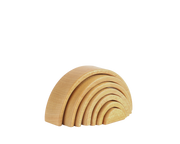
| Grading or stacking towers | Around 2 | Ordering by size, precise placement | No post to guide them, so it is a step up in difficulty |
| Counting stackers (1 to 10 rings) | Around 3 | Number, quantity, one-to-one matching | Pairs naturally with an abacus and number puzzles |
| Fraction cups or pieces | 4 to 5 | Parts and wholes, comparing amounts | Best introduced through play, not drills |
How do you choose a first shape sorter?
Choose a simple, sturdy sorter with large pieces and just one to three shapes, starting with a circle. A lid or drawer that a toddler can open themselves keeps the game going without your help.
- Start with circles. A circle fits whichever way it turns, so early success is almost guaranteed. Squares come next, then triangles, then rectangles and more complex shapes.
- Fewer holes is better at first. A box with eight shapes is overwhelming at 14 months. If yours has many holes, offer just one or two pieces and hide the rest.
- Chunky pieces. Every piece for an under-3 should be too large to swallow and easy for a small hand to hold.
- Easy retrieval. Children want to get the shapes back out. A drawer, an open top or a lid that lifts easily matters more than you'd think.
- Clear contrast. Plain natural wood or a few clear colours help a toddler see the shape outline.
- Room to grow. A sorting box with several shapes can be introduced gradually, piece by piece, over a year or more.
How do you play with stacking toys and shape sorters?
Show the move once, slowly and without words, then hand the toy over and step back. Let your child explore in their own way, including knocking things down, and resist fixing their mistakes.
- Set it out simply. Put the toy on a low table or a tray on the floor, with nothing else competing for attention.
- Demonstrate slowly. Take one ring off, slowly. Put it back on, slowly. Silent, slow movement is easier to follow than explanation.
- Hand it over. Give your child the next piece and wait. Waiting is the hardest part for adults.
- Let mistakes stand. A ring in the wrong order is not wrong for a 15-month-old; it is an experiment. The toy itself shows them when something doesn't fit.
- Name, don't quiz. Narrate what they do: "You put the big one on." This builds vocabulary without pressure.
- Celebrate the knock-down. Knocking down is part of the game, and it teaches cause and effect.
- Stop while it is fun. When attention drifts, pack it away together. Putting the toy back on the shelf is part of the learning too.
A few ways to stretch the same toys as children grow:
- Hide a shape under a cup and ask them to find it.
- Line up rings from biggest to smallest on the floor instead of on the post.
- Sort the pieces into colour groups using small bowls.
- Count each ring as it goes on, then count backwards as it comes off.
- Build the tallest tower possible, then measure it against a teddy.

What comes after stacking and sorting?
After simple stacking and sorting, children move on to ordering by size without a guide, sorting by two features at once, puzzles, counting and early fractions. Many good toys bridge these stages.
A typical progression looks like this:
- Take apart: pulling rings off, emptying boxes, knocking towers down.
- Put together in any order: rings on a post, posting a circle.
- Put together with intention: nesting cups, towers of cubes, posting several shapes.
- Order by size: grading towers and nesting sets without a post to help.
- Sort and classify: by shape, by colour, then by shape and colour together.
- Count and compare: 1 to 10 stacking rings, a counting abacus, fraction cups.
- Plan and build: open-ended block building, patterns, bridges and arches.
Fine motor toys such as nut-and-bolt boards and lacing pair well with this progression. See our fine motor activities by age guide for more ideas, and our educational toys for stackers and sorters at each stage.
What if my child isn't interested or gets frustrated?
Usually the toy is a little too hard, there are too many pieces, or it is competing with other toys. Make it simpler, offer it at a calm time and try again in a week or two.
- Remove pieces. Offer two rings instead of six, or one shape instead of five.
- Go back a step. If posting a square frustrates them, swap to a circle or a simple open box for dropping things into.
- Rotate it out. Put the toy away for a fortnight. It often comes back as a favourite. Our guide to Montessori shelves and toy rotation explains how.
- Follow their play. If your toddler prefers to fill the sorter with blocks and carry it around, that is filling, transporting and planning. It counts.
- Check the height. A child perched on a too-tall chair, or stooping over the floor, has less control. A table and chair at the right height makes fiddly work easier. Our size guide shows the right sizes by age.
Choosing Toys That Grow With Your Child
You don't need every stacker and sorter. One good set at each stage, rotated with other toys, is plenty. If you would like the progression worked out for you, Chapters sends a new box of wooden toys matched to your child's age every 3 months, with a printed play guide that shows how to introduce each one. Or start with our wooden toys guide to choose well on your own.
Frequently Asked Questions
What age is a shape sorter for?
Most children enjoy a simple shape sorter from around their first birthday, starting with posting a circle or a ball. Between 18 months and 2 years they usually manage two or three shapes with some turning, and between 2 and 3 most can sort several shapes. Start with one or two shapes and add more as your child's skills grow.
When do babies start stacking rings?
Babies usually start by pulling rings off a stacker and mouthing them in the second half of their first year. Putting rings back on, in any order, often follows after the first birthday. Putting them on in size order, biggest to smallest, tends to come later, often between 2 and 3. Every child develops at their own pace, so treat ages as a rough guide.
Which shape should a toddler learn first?
Start with the circle. A round piece fits its hole whichever way it is turned, so toddlers succeed quickly and want to try again. Once circles are easy, introduce the square, then the triangle, which needs more careful turning. Rectangles, stars and other complex shapes are best left until children are confident with the first three.
Why does my toddler only knock towers down?
Knocking towers down is a normal and useful stage. It teaches cause and effect, lets toddlers practise reaching and swiping, and is simply fun. Taking apart nearly always comes before building up. Keep building towers for them to knock over, and offer chances to add a block of their own. Building usually follows within months.
Are stacking toys good for learning maths?
Yes. Stacking and nesting toys introduce early maths ideas through play: bigger and smaller, order, height, balance and, later, counting. A child who puts rings in size order is practising seriation, a foundation for number sense. Counting stackers, an abacus and fraction cups extend the same skills for 3 to 5 year olds.
Should I correct my toddler when they stack in the wrong order?
No, not at first. For young toddlers, any order is a successful experiment, and the toy itself shows them when something doesn't sit right. Instead of correcting, slowly model the move yourself now and then, and describe what you see: "That big one is on top." Size order usually emerges by itself between 2 and 3.
Are wooden shape sorters safe for babies?
A well-made wooden shape sorter is safe for babies when every piece is too large to swallow, the edges are smooth and the finish is tested to a toy safety standard. Check that knobs, lids and end caps cannot come loose. Australia bans small parts in toys for children up to and including 36 months, and play should always be supervised.
A table, a chair, and a new chapter of play.
Chapters: a solid-wood table and chair at their height, with the next size sent as they grow, and a new box of wooden toys for their age every 3 months.
