



Playroom ideas for small spaces: a calm play corner at home
Playroom ideas for small homes: how to zone a play corner, the furniture you need, table heights by age, storage and rotation, and how to keep it safe and calm.
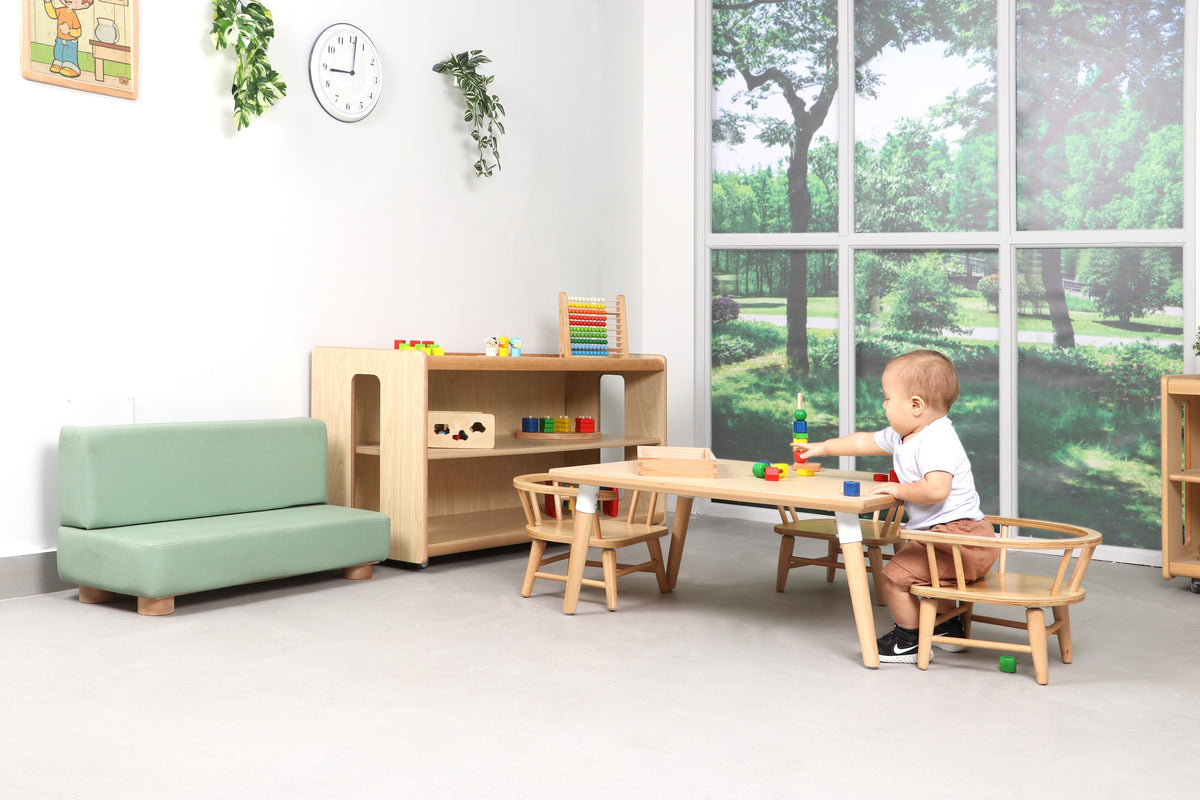
The short answer: A calm playroom in a small home needs four things: a low open shelf holding 6 to 10 toys, a table and chair at your child's height, a soft corner for books, and closed storage for everything else. Even a corner of the living room works if each zone has a clear job, toys sit at child eye level and you rotate them every week or two.
Key Points
- You don't need a spare room. A corner with clear zones works as well as a whole playroom.
- Low, open shelves with few toys make a space calmer and easier to tidy.
- A table and chair at the right height (a 21 cm seat and 40 cm table for most 2 to 3 year olds) turns a corner into a workspace.
- Store most toys out of sight and rotate them, rather than displaying everything.
- Anchor shelves and storage units to the wall, and keep furniture away from windows and blind cords.
How do you set up a playroom in a small space?
Pick one corner or wall, divide it into a few small zones, choose furniture at your child's height, and keep only a handful of toys out. Start small and adjust after a week of watching how your child actually uses it.
- Choose the spot. The best play space is where your child already wants to be, which is usually near you. A corner of the living room or kitchen often gets more use than a spare bedroom down the hall.
- Clear it completely. Start with an empty floor. It is easier to add than to edit.
- Define the edges. A rug, a low shelf placed sideways or a change of flooring tells a child "this is the play space".
- Plan two to four zones. Most small homes fit a shelf zone, a table zone and a soft book zone. Add a pretend play or movement zone if you have room.
- Bring in child-height furniture. A low shelf, a table and a chair sized to your child.
- Choose 6 to 10 toys. Put the rest in closed storage for rotation.
- Watch and adjust. After a week, notice what gets used and what gets ignored, and change one thing at a time.
What zones does a play space need?
A small play space works best with three core zones: a shelf for toys, a table for focused work, and a soft spot for books and rest. Pretend play and movement can be added or rotated in as space allows.
| Zone | What goes in it | Small-space tip |
|---|---|---|
| Toy shelf | 6 to 10 toys, each with its own spot, some on trays or in shallow baskets | One low two-tier shelf is plenty; leave gaps between toys |
| Table zone | A table and chair at the child's height for puzzles, drawing, play dough and snacks | Push the table against a wall; one chair is enough for one child |
| Book and rest corner | A basket or forward-facing rack with a few books, a cushion or soft seat | Use the corner itself: two walls make it feel cosy |
| Pretend play | A small kitchen, a doll's bed, dress-ups or a shop | Rotate it in and out rather than keeping it out all year |
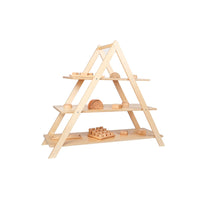
| Movement | A small climbing triangle, balance board or open floor | Clear floor space counts; it doesn't need equipment |
| Art | Paper, crayons, chunky brushes, a small easel | Keep supplies in one lidded box and bring it to the table |
Early learning rooms use the same idea on a bigger scale, with clearly defined areas for each kind of play. At home, three zones done well are better than six crammed in.
What furniture do you really need for a small playroom?
You need a low open shelf, a table and chair at your child's height, and some closed storage. Everything else is optional.
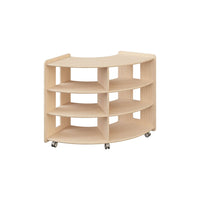
- A low open shelf. Low enough for your child to reach the top shelf without climbing. Two tiers suits most homes. Open shelves let children see and choose; that is what makes them use toys independently.
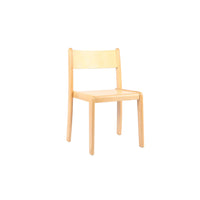
- A table and chair. A child-sized table gives them a place for focused work: puzzles, drawing, threading, play dough. It also makes meals and snacks easier. Size matters more than style, so see the table below.
- Closed storage. A cupboard, a lidded box or under-bed tubs for the toys that are resting. Out of sight really does mean out of mind for young children, which is what keeps a small space calm.
- A soft seat or cushion. Somewhere to sit with a book. A floor cushion or a small soft chair works.
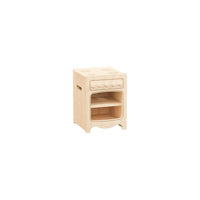
- Optional: a small kitchen or other role-play piece, an easel, or a mirror fixed securely at floor level for babies.
Skip anything that only does one thing and takes a lot of floor space. In a small home, every piece needs to earn its place.
What size table and chair does my child need?
Choose the size by your child's age and height: their feet should rest flat on the floor, knees at about a right angle, and forearms resting on the table just below elbow height. The chair and table should come from the same size mark.
| Size mark | Typical age | Seat height | Table height |
|---|---|---|---|
| C01 | 0 to 1 years | 13 cm | 30 cm |
| C02 | 1 to 2 years | 17 cm | 36 cm |
| C0 | 2 to 3 years | 21 cm | 40 cm |
| C1 | 3 to 4 years | 26 cm | 46 cm |
| C2 | 4 to 6 years | 31 cm | 53 cm |
Our chart follows the BS EN 1729 size marks plus two smaller sizes for babies and young toddlers. Children grow at different rates, so check the fit, not just the age. The size guide has the full chart and how to measure, and kids table and chairs by age goes into more detail.
How do you store toys in a small playroom?
Keep a few toys out on open shelves and store the rest out of sight in labelled boxes, then rotate. Give every toy a home so tidying is quick for both you and your child.
- One toy, one spot. Each toy has its own place on the shelf. Children learn where things go, and pack-up takes minutes.
- Use trays and shallow baskets. A tray holds a puzzle and its pieces, or a set of blocks, and makes the activity easy to carry to the table. See our trays.
- Rotation boxes. Store resting toys in a few lidded boxes, grouped by type or by week. Label them with a photo so swapping is easy.
- Go vertical, carefully. Tall cupboards for adult-managed storage are fine if they are anchored to the wall and the top shelves hold things children shouldn't reach.
- Use dead space. Under the bed, the top of a wardrobe, the cupboard under the stairs.
- One in, one out. When a new toy arrives, an old one goes to rotation, a friend or a charity shop.
Our step-by-step guide to Montessori shelves and toy rotation covers how many toys and how often to swap.

How do you make a play corner feel calm?
Use fewer toys, softer colours, natural materials and good light, and keep walls fairly bare. Calm spaces help children settle into longer, deeper play.
- Fewer things in view. Clutter is the main cause of a busy-feeling room. Fewer toys out is the single biggest change you can make.
- Natural, muted colours. Timber, linen, soft neutrals and one or two gentle accents. The toys and the child's art supply plenty of colour.
- Light. Natural light where possible, and a warm lamp for evenings rather than bright overhead light.
- Art at their eye level. Hang one or two of your child's pictures low, where they can see them, and change them often.
- Soft underfoot. A rug defines the space, softens sound and makes floor play comfortable.
- A plant or a nature basket. Pinecones, shells and smooth stones (large ones, for older children) bring texture indoors.
Play Corner Ideas for Different Small Spaces
Almost any room can host a play corner. The trick is to work with the space you have, not against it.
| Space | What works | Watch for |
|---|---|---|
| Living room corner | Low shelf as a divider, rug, table against the wall, book basket | Keep adult cables and remote controls out of reach |
| Child's bedroom | Shelf and table on one wall, books by the bed | Keep play zone separate from the sleep area so bedtime stays calm |
| Kitchen or dining nook | Child-height table near the bench, a small basket of toys, a role-play kitchen | Keep away from the oven and hot drinks |
| Hallway or landing | A narrow shelf and a cushion for a reading nook | Not near stairs; keep walkways clear |
| Apartment with no spare corner | A rolling cart or one shelf that becomes the "play shelf", with a rug rolled out each day | Store rug and toys away each night to reclaim the room |
How do you keep a small playroom safe?
Anchor every shelf and storage unit to the wall, keep furniture away from windows and blind cords, and match toys to the youngest child who uses the space.
- Anchor furniture. Children climb shelves. Product Safety Australia advises anchoring furniture and televisions to the wall to prevent them toppling.
- Windows and balconies. Don't put shelves, tables, chairs or toy boxes under windows or near balcony railings, where a child can climb up.
- Blind and curtain cords. Keep cords tied up and well out of reach, and move cots, beds and furniture away from them.
- Toy boxes. Choose open baskets or lightweight lids. A heavy hinged lid can trap fingers or worse.
- Small parts and siblings. If an older child has toys with small parts, keep them on a high shelf or in a separate space, away from under-3s.
- Clear floors. Do a quick pack-up before the evening, so nobody trips in the dark.
Furniture as Your Child Grows
The table and chair are the pieces children outgrow fastest. Chapters is a membership built around that. Your child gets a solid-wood table and chair at their height to keep, and we send the next chair and table legs free as they grow. A new box of wooden toys for their age arrives every 3 months. It costs $149 every 3 months, or $499 for a year upfront, and members get 15% off everything in the shop. If you would rather buy, see our home furniture.
Frequently Asked Questions
How do I make a playroom in a small house?
Pick one corner, ideally near where you spend time, and divide it into three zones: a low shelf with 6 to 10 toys, a table and chair at your child's height, and a soft corner with books. Store the rest of the toys out of sight and rotate them every week or two. A rug helps define the space.
How many toys should be in a playroom?
About 6 to 10 toys out at a time suits most toddlers and preschoolers, plus a basket of books. Store the rest in closed boxes and rotate every week or two. Fewer toys on display makes a small room calmer and tidier, and helps children play for longer with each toy rather than tipping everything out.
What furniture does a play corner need?
A play corner needs a low open shelf your child can reach, a table and chair sized to your child, and some closed storage for toys that are resting. A floor cushion or soft seat for books is a nice extra. Choose pieces that serve more than one purpose, and anchor shelves and storage units to the wall.
What height should a toddler table be?
For most 1 to 2 year olds, a table around 36 cm high with a 17 cm seat fits well. For 2 to 3 year olds, it is about 40 cm with a 21 cm seat, and for 3 to 4 year olds about 46 cm with a 26 cm seat. Check that feet rest flat and forearms sit on the table just below the elbows.
How do I stop a small playroom getting messy?
Keep fewer toys out, give each one its own spot on a low open shelf, and use trays and baskets so sets stay together. Pack up together before meals and bedtime, which takes minutes when everything has a home. Rotate toys from closed storage instead of adding more, and follow a one-in, one-out rule for new toys.
Can a play corner work in a living room?
Yes, and it is often the best spot because young children like to play near their parents. Use a rug and a low shelf to mark the area, push a child-height table against a wall, and add a book basket. Choose furniture in natural timber and soft colours so it sits comfortably alongside the rest of the room.
Is it safe to put shelves in a child's play area?
Yes, as long as shelves are low, stable and anchored to the wall, since children often climb them. Keep shelves and other furniture away from windows, balcony railings and blind cords. Put heavier items on the bottom shelf, keep the top clear of anything that could fall, and store small-parts toys out of reach of under-3s.
A table, a chair, and a new chapter of play.
Chapters: a solid-wood table and chair at their height, with the next size sent as they grow, and a new box of wooden toys for their age every 3 months.
