



Pre-writing skills and letter tracing: from scribbles to letters
Letter tracing and pre-writing skills by age: the stroke order from scribbles to letters, pencil grip stages, posture and table height, and tracing boards.

The short answer: Writing grows in stages: scribbles from about 1, then copying lines and circles around 2 to 3, crosses around 4, squares and diagonals around 4 to 5, and triangles and letters from about 5. Pre-writing skills such as hand strength, a developing grip and good posture at a right-height table come first. Finger tracing on letter boards suits most children from about 3 to 4.
Key Points
- Pre-writing skills are the hand, body and visual skills children need before they can form letters.
- Children usually master pre-writing strokes in a predictable order: vertical line, horizontal line, circle, cross, square, diagonal, triangle.
- Pencil grip develops from a fist to a finger grip over several years. Don't rush it.
- Posture matters: feet flat, table just below elbow height, paper steadied by the other hand.
- Trace with a finger first, on grooved boards, sand or large shapes, before tracing with a pencil.
- Ask your child's kinder or school which handwriting style they use, as Australian states differ.
What are pre-writing skills?
Pre-writing skills are the abilities children need before they can write letters comfortably. They include hand strength, finger control, a working grip, copying basic strokes, and sitting in a stable position.
- Hand and finger strength: to hold a crayon steadily without tiring.
- Finger isolation: moving the thumb, index and middle fingers on their own.
- Bilateral coordination: one hand writes while the other holds the paper.
- Crossing the midline: reaching across the body, needed to write a line from left to right.
- Visual-motor skills: seeing a shape and making the hand reproduce it.
- Pre-writing strokes: the lines and shapes that make up every letter.
- Posture and stability: a steady trunk and shoulder that let the hand move freely.
Most of these are built through everyday play long before a child picks up a pencil. Our guide to fine motor activities by age has ideas for each stage.
What are the stages from scribbling to writing letters?
Children move from random scribbles to controlled lines, then shapes, then letters. They usually imitate a stroke (copy it while watching you) a few months before they can copy it from a finished example.
| Age (roughly) | What you may see | Try this |
|---|---|---|
| 12–18 months | Random scribbles, whole-arm movements, crayon held in a fist | Chunky crayons on large paper taped down; finger painting |
| 18 months–2 years | Back-and-forth and circular scribbles; imitates a vertical line | Drawing on an easel or paper on the wall; chalk outside |
| 2–3 years | Imitates horizontal lines and circular strokes; starts to copy a vertical line | "Rain" lines down, "roads" across; drawing round and round |
| 3 years | Copies a circle; may imitate a cross | Finger tracing shapes; drawing faces; playdough snakes made into shapes |
| 4 years | Copies a cross; draws a simple person; may write some letters, often from their name | Grooved letter boards; tracing in sand; first letters of their name |
| 4–5 years | Copies a square and diagonal lines; draws more detailed pictures | Mazes, dot-to-dots, tracing letters with a crayon |
| 5 years and up | Copies a triangle; writes their name and many letters | Writing labels, cards and lists as part of play |
The order matters more than the exact age. A triangle needs diagonal lines, and many letters (such as k, v, w, x, y and z) need diagonals too. That is why pushing letter writing before a child can copy a cross and square often leads to frustration.
How does pencil grip develop?
Grip moves from the whole hand to the fingertips over several years, roughly in four steps.
| Grip | Typical age | What it looks like |
|---|---|---|
| Fist grip | 1–2 years | Crayon held in a closed fist, movement comes from the shoulder |
| Fingers-down grip | 2–3 years | Hand over the crayon, fingers pointing down, movement from the elbow and wrist |
| Early finger grip | 3–4 years | Crayon held with the thumb and several fingers; hand moves as one unit |
| Mature (tripod) grip | 4–6 years | Held between thumb and index finger, resting on the middle finger; small finger movements do the writing |
Some children settle on a four-finger version of the tripod grip. If it is comfortable, controlled and does not tire them, it usually works well.
Ways to encourage a good grip without correcting all the time:
- Short crayons and chalk. Broken crayons leave room for only the fingertips, which naturally leads to a finger grip.
- Vertical surfaces. Drawing on an easel or paper taped to the wall puts the wrist in a good position and builds shoulder strength.
- Pinching play. Pegs, tongs, tweezers and tearing paper strengthen the same fingers used to hold a pencil.
- Chunky or triangular crayons for younger children. They are easier to hold for small hands.
Why do posture and table height matter for writing?
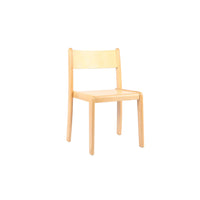
A child writes with their whole body, not just their hand. When they sit with feet flat, knees bent to about 90° and forearms resting on a table just below elbow height, the trunk and shoulder are stable and the fingers can make small, controlled movements.
When the furniture is wrong, you see it in the writing. A table that is too high lifts the shoulder and makes the arm tire. A chair that is too high leaves feet dangling, so children wriggle for balance. A low table makes them slump and press too hard.
| Age | Seat height | Table height |
|---|---|---|
| 2–3 years | 21 cm | 40 cm |
| 3–4 years | 26 cm | 46 cm |
| 4–6 years | 31 cm | 53 cm |
| 6–8 years | 35 cm | 59 cm |
These are the size marks we use for our tables and chairs. Check the fit with your child, as children of the same age vary in height. Our guide to kids table and chair heights by age has the full fit check.
A few more posture tips for writing:
- Angle the paper slightly, roughly in line with the writing arm.
- Encourage the non-writing hand to hold the paper still.
- Sit square to the table, not twisted sideways.
- Use good light from the side opposite the writing hand, so the hand doesn't shadow the page.

When should my child start letter tracing?
Most children are ready for letter tracing between about 3 and 5, once they can copy a circle and a cross and are showing interest in letters. Start with finger tracing, and move to crayons and pencils later.
Signs your child is ready:
- They can copy a vertical line, horizontal line and circle.
- They are starting to copy a cross.
- They point out letters, especially the first letter of their name.
- They pretend to write in play: shopping lists, cards, signs.
- They can sit at a table for a few minutes of focused drawing.
If your child is not interested yet, keep building the foundations through drawing, playdough, puzzles and fine motor play. Readiness matters more than an early start.
How do I use letter tracing boards well?
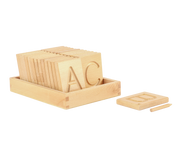
Trace big before small, finger before pencil, and always from the correct starting point. A grooved tracing board guides the finger along the right path, so the movement is learned correctly from the start.
- Show it slowly. Trace the letter yourself with one finger, saying its sound as you go.
- Finger first. Your child traces the groove with their index finger, starting at the dot or arrow.
- Use a stylus or wooden stick. Once the finger path is confident, a stick in the groove brings in the grip.
- Move to a soft surface. Trace the letter in a tray of sand or salt, or with a finger in shaving foam.
- Then crayon on paper. Large letters first, tracing over a dotted or highlighted shape.
- Finally, copy. Writing the letter beside a model, then from memory.
Most letters start at the top and are formed with downward strokes. Getting the starting point right early saves untangling habits later. Many teachers introduce letters in groups that share a movement, for example the "round" letters c, a, d, g, o and q, which all begin with the same anticlockwise curve.
Capitals or lowercase first? Capitals are mostly straight lines and are often easier to form. Lowercase letters are what children read and write most. A practical approach: start with the letters in your child's name, written the way their school will expect, usually a capital first letter followed by lowercase.
What pre-writing activities work beyond paper?
Some of the best writing practice happens away from pencils and worksheets.
- Drawing on vertical surfaces: easels, chalkboards and paper taped to the wall.
- Water painting: a brush and a cup of water on a fence or paving.
- Sand and salt trays: drawing lines, circles and letters with a finger.
- Playdough letters: rolling snakes and bending them into shapes.
- Threading and lacing: both hands working together, with precision.
- Puzzles and pegboards: visual-motor skills and pinch strength.
- Big movements: drawing huge circles and lines in the air, or with ribbons.
- Mazes and dot-to-dots: controlled lines with a clear start and finish, from about 4.
What about left-handed children and other languages?
Let hand preference emerge naturally. Most children settle on one hand during the preschool years. Never switch a child's preferred hand.
For left-handed writers:
- Angle the paper the other way, roughly in line with the left arm.
- Encourage them to hold the pencil a little further from the tip, so they can see what they write.
- At a shared table, seat them on the left of a right-handed child so elbows don't bump.
Children learning to write in a second language can use the same approach: strokes first, finger tracing, then crayons. Arabic, for example, is written from right to left, so tracing practice should follow that direction. Our Arabic letter and number puzzles suit children from 3, and our guide to teaching Arabic to kids at home covers routines for bilingual families.
Common Mistakes to Avoid
- Starting with worksheets too early. Small lines on small paper are hard for young hands. Big movements come first.
- Correcting grip constantly. Offer short crayons and pinching play instead of repeatedly moving fingers into place.
- Ignoring the furniture. An adult chair at the kitchen bench makes writing much harder.
- Tracing without the right start point. Habits form fast; show where each letter begins.
- Long sessions. A few minutes, often, is better than one long sitting.
Where to Go From Here
Start with what your child can do now. If they are still scribbling, give them big paper, an easel and chunky crayons. If they can copy a circle and a cross, bring out a finger-tracing board. Browse our letter and number toys, including trace-me letter and number boards. Chapters members receive a solid-wood table and chair at their child's height, with the next size sent as they grow and theirs to keep, plus age-matched wooden toys every 3 months.
Frequently Asked Questions
What are pre-writing skills?
Pre-writing skills are the abilities children need before they can write letters comfortably. They include hand and finger strength, finger control, using both hands together, a developing pencil grip, good sitting posture, and copying the basic strokes that make up letters: vertical and horizontal lines, circles, crosses, squares, diagonal lines and triangles. Most are built through play.
What age should a child start tracing letters?
Most children are ready to trace letters between about 3 and 5 years, once they can copy a circle and are starting to copy a cross. Begin with finger tracing on grooved letter boards or in sand, then move to crayon on paper. If your child shows little interest, keep building hand skills through drawing and play first.
What is the order of pre-writing strokes?
Children usually master pre-writing strokes in this order: vertical line, horizontal line, circle, cross, square, diagonal lines, and then a triangle. They tend to imitate each stroke while watching an adult a few months before they can copy it from a finished example. Letters with diagonal lines, such as k, v and x, usually come later.
What age should a child hold a pencil correctly?
Pencil grip develops gradually. Toddlers hold crayons in a fist, around 2 to 3 the fingers point down over the crayon, around 3 to 4 they use the thumb and several fingers, and between about 4 and 6 most move to a mature tripod grip. A comfortable four-finger grip can also work well if it is controlled.
Are tracing boards good for learning letters?
Yes. Grooved tracing boards guide the finger along the correct path and from the correct starting point, so children learn the movement of each letter before using a pencil. Finger tracing also helps children feel the shape of letters. Use them alongside drawing and play, and move on to crayon tracing once the finger path is confident.
Should my child learn capital or lowercase letters first?
Capitals are mostly straight lines and are often easier to form, but lowercase letters are what children read and write most. A practical approach is to start with the letters in your child's name, written as their school will teach it, usually a capital first letter followed by lowercase. Ask the school which handwriting style they use.
What height table is best for a child learning to write?
The best table lets your child sit with feet flat, knees at about 90° and forearms resting on the tabletop just below elbow height. As a guide, a 3 to 4 year old suits a table about 46 cm high with a 26 cm seat, and a 4 to 6 year old a 53 cm table with a 31 cm seat.
How can I help my left-handed child write?
Let your child's hand preference develop naturally and never switch it. Angle the paper to follow the left arm, encourage them to hold the pencil a little higher up so they can see their writing, and seat them on the left of a right-handed child at a shared table. Otherwise, the stages and activities are the same.
A table, a chair, and a new chapter of play.
Chapters: a solid-wood table and chair at their height, with the next size sent as they grow, and a new box of wooden toys for their age every 3 months.
